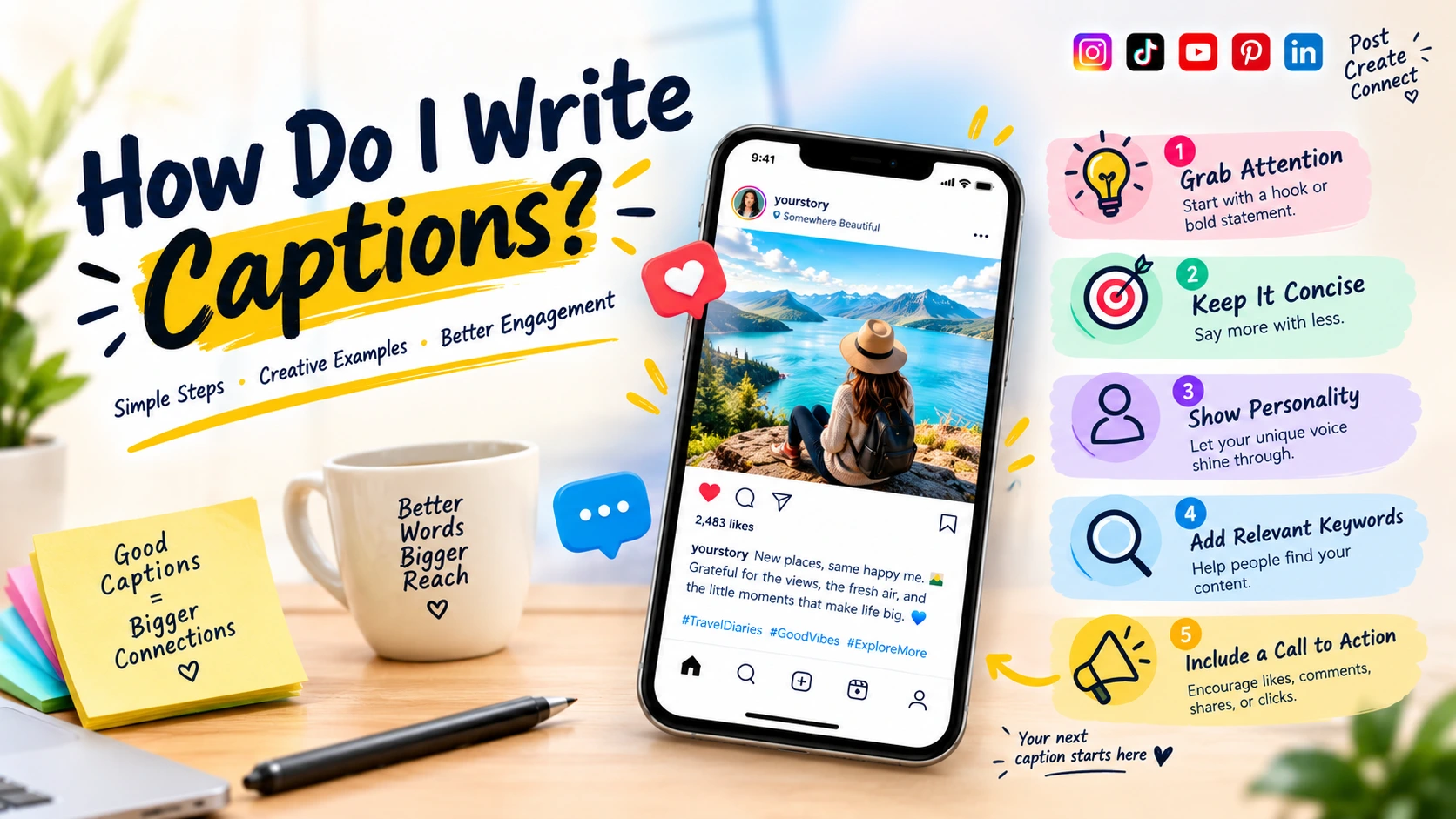
How Do I Write Captions? A Simple Guide With 225 Examples
Ever stare at your photo or social media post, wondering what to write in the caption? You’re not alone. A great caption can add personality, tell a story, express your feelings, and Encourage people to engage with your content. But writing one doesn’t have to be difficult. Whether you need a short Instagram caption, a funny line for your selfie, or an engaging caption for your business, the right approach makes all the difference. In this guide, you’ll discover simple steps, practical writing formulas, and creative examples to help you write captions with confidence. Let’s find your perfect words!
Writing a caption can feel surprisingly difficult, even when you already know what you want to post. You may have a great photo, a memorable experience, or an exciting announcement, but finding the right words is another challenge.
So, how do I write captions that sound natural, express the right message, and connect with my audience?
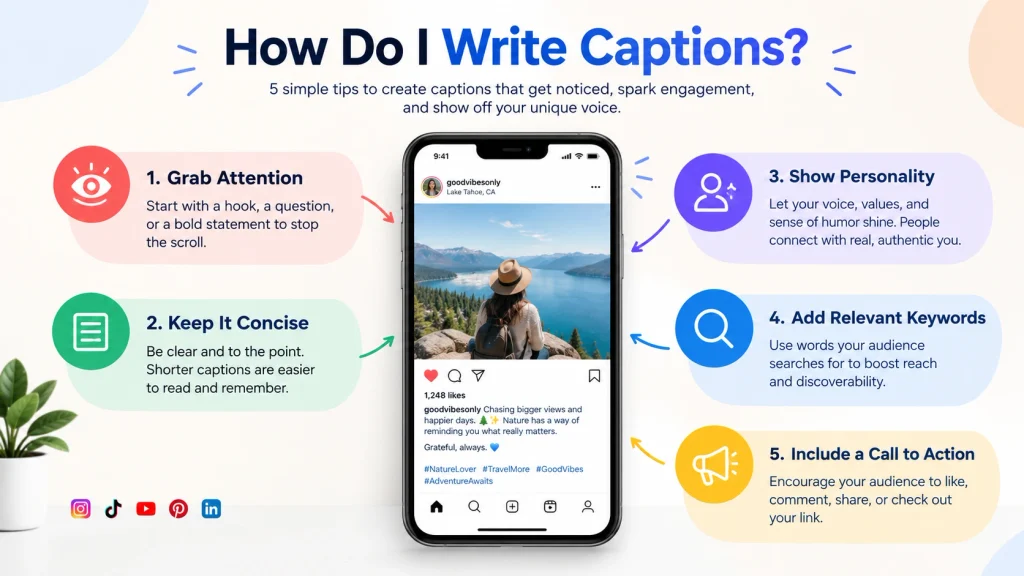
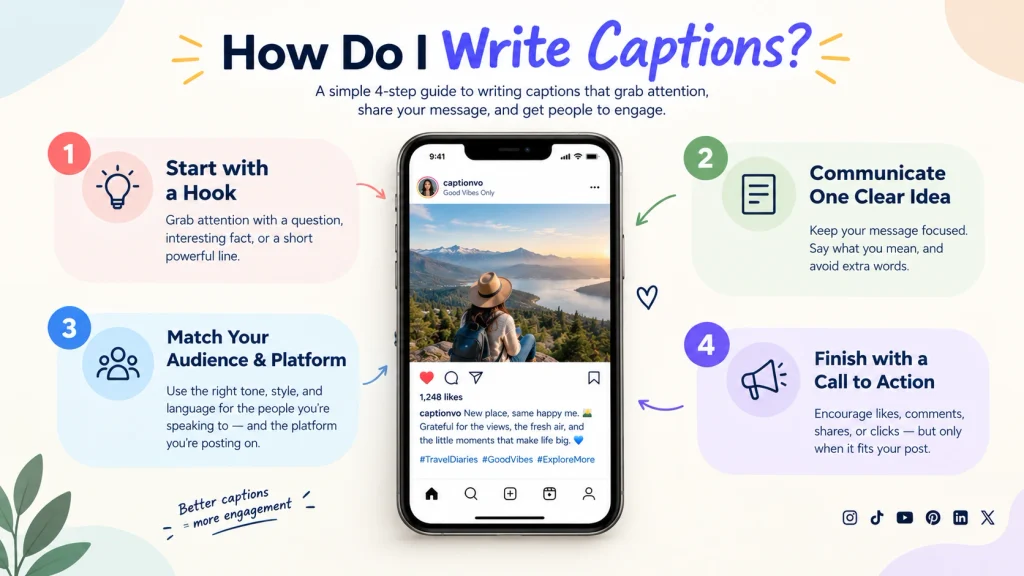
Start with one clear idea. Decide what you want readers to understand or feel, write an opening that fits your content, add a meaningful detail, and remove anything unnecessary. Your caption can be one sentence or several paragraphs, depending on what the post needs.
This guide explains the caption-writing process, provides 225 original caption ideas across 15 useful categories, and shows you how to adapt your wording for different platforms.
How Do I Write Captions? Start With These Simple Steps
Use this process whenever you are unsure what to write.
- Identify your purpose. Are you sharing a memory, making people laugh, explaining something, or promoting a product?
- Understand your audience. Consider what your readers care about and the language they naturally use.
- Choose one main idea. Avoid trying to express several unrelated thoughts in the same caption.
- Write an opening line. Begin with a relevant observation, question, feeling, or useful detail.
- Add context. Share something that the image or video does not communicate by itself.
- Choose your tone. Be playful, thoughtful, emotional, informative, or professional as appropriate.
- Make it readable. Use clear sentences, short paragraphs, and line breaks when helpful.
- Choose a suitable ending. A question, invitation, conclusion, or call to action can work when it fits the post.
- Edit before publishing. Check accuracy, grammar, relevance, and unnecessary wording.
Example: Improve an ordinary caption
Basic version: Had a great day.
Improved version: A spontaneous afternoon, good company, and the kind of memories that make an ordinary day special.
The second version adds context and personality. However, if the photo already communicates everything you want to say, a short caption such as “A day well spent” may be the better choice.
The objective is not to make every caption longer. It is to make every word count.
What Makes a Good Caption?
An effective caption supports the image, video, or message while giving readers a reason to care.
A good caption usually has five qualities:
- Clarity: The message is easy to understand.
- Relevance: The words match the content.
- Personality: The writing sounds appropriate for the creator or brand.
- Value: The caption adds a feeling, detail, story, or useful takeaway.
- Purpose: The reader understands the intended message or next step.
For example, “New product available” communicates an announcement. “Meet your new everyday essential: a lightweight design made for busy days” communicates more context, provided those product details are accurate.
Not every caption needs a dramatic hook, multiple hashtags, or a question. The right approach depends on your content and audience.
The Best Caption-Writing Formula
A flexible formula for many social media posts is:
Hook + Context + Value + Optional Call to Action
- Hook: Give the reader a relevant reason to pay attention.
- Context: Explain what the post is about.
- Value: Add a useful detail, personal experience, feeling, or benefit.
- Call to action: Invite the reader to take one appropriate next step, if necessary.
For example:
Hook: Feeling overwhelmed by your to-do list?
Context: I used to start my mornings by answering every notification.
Value: Now I choose three priorities before opening my inbox.
Call to action: What helps you stay focused?
Combined caption:
“Feeling overwhelmed by your to-do list? I used to start my mornings by answering every notification. Now I choose three priorities before opening my inbox, and it gives me a clearer place to start. What helps you stay focused?”
For an aesthetic photograph, “Quiet moments, clearer thoughts” may be enough. Treat the formula as a helpful starting point, not a rule for every post.
225 Caption Ideas for Different Social Media Posts
The following 15 collections offer different tones and use cases. Adapt the examples to your actual experience, personality, audience, and platform instead of copying every caption without context.
1. Short Captions for Simple, Memorable Posts
Short captions are useful when the visual already tells most of the story. They work well for casual photos, minimalist posts, quick updates, and moments when you want your image to remain the focus.
- Less noise, more life.
- Here for this moment.
- A little more present.
- Making room for good things.
- Today feels right.
- Small moment, big meaning.
- Nothing extra needed.
- Life, unfiltered.
- Keeping it simple.
- Just my kind of day.
- A moment worth keeping.
- Let the feeling stay.
- Here, and happy.
- One for the memories.
- Simple things, real joy.
Best for: Instagram photos, profile pictures, casual updates, and minimalist aesthetics.
Why this style works: Brevity makes the message easy to understand quickly. A short caption is especially useful when extra explanation would distract from the image.
2. Funny Captions That Show Your Personality
Funny captions work best when the humor matches the photo and feels natural. Try playful observations, relatable situations, or gentle self-deprecating humor rather than forcing a joke into every post.
- I came, I saw, I forgot why I came.
- Currently accepting compliments and snacks.
- My plans and my energy have different schedules.
- Professional overthinker, amateur adult.
- Looking organized from a safe distance.
- I call this outfit a successful experiment.
- Mentally on vacation, physically doing laundry.
- Confidence level: posted before overthinking it.
- I had a plan. Then I met a distraction.
- Too glam to explain what happened.
- My camera roll knows too much.
- A serious face hiding unserious thoughts.
- Doing my best, with occasional buffering.
- Plot twist: I made it on time.
- If laughter burns calories, consider this productive.
Best for: Friend groups, selfies, casual Reels, funny videos, and everyday lifestyle posts.
Why this style works: Relatable humor gives people a recognizable situation to respond to. Make sure the joke suits your audience and does not embarrass someone featured in the post.
3. Aesthetic Captions for Beautiful Photos
Aesthetic captions complement the mood of a photograph instead of explaining every detail. They are especially useful for sunsets, architecture, outfits, quiet mornings, nature, and carefully styled images.
- Somewhere between stillness and possibility.
- Golden light, softer thoughts.
- A little poetry in an ordinary day.
- Let the colors tell the story.
- Quiet beauty, lasting feeling.
- The art of noticing.
- Soft light, strong memories.
- Finding magic in the in-between.
- A slower kind of beautiful.
- Where the moment meets the mood.
- Collecting shades of calm.
- Beauty without the need for explanation.
- A frame full of feeling.
- Ordinary hours, extraordinary light.
- A little less rush, a little more wonder.
Best for: Instagram feeds, photography, fashion, travel, lifestyle, and Pinterest inspiration.
Why this style works: Mood-driven wording helps communicate the feeling behind a visual. Choose words that reflect the actual image rather than relying on vague aesthetic phrases every time.
4. Attitude Captions for Confident Posts
Attitude captions communicate confidence, independence, ambition, or self-respect. The strongest examples express a clear point of view without needing to insult other people.
- Comfortable in my own direction.
- I know what I bring to the table.
- Built on lessons, not opinions.
- My standards speak before I do.
- Quiet confidence, clear boundaries.
- Growing beyond old expectations.
- I choose progress over approval.
- Not competing, just becoming.
- Different priorities, different perspective.
- Self-respect is always in style.
- Focused on what I can control.
- No announcement needed for personal growth.
- I move with purpose.
- Less proving, more improving.
- My journey, my pace.
Best for: Selfies, personal-brand posts, milestone photographs, fitness updates, and motivational content.
Why this style works: Confident language reinforces a personal identity. Use it when the photo genuinely reflects independence or growth rather than making every post sound confrontational.
5. Cute Captions for Sweet Moments
Cute captions are ideal for warm, cheerful photographs and small moments that make everyday life feel special. A gentle tone, affectionate observation, or playful detail can be more effective than an elaborate quote.
- A pocketful of happy.
- Smiling at the little things.
- Sunshine with a side of giggles.
- This moment deserves a tiny heart.
- Collecting reasons to smile.
- Happiness looks good from here.
- Just a little bundle of good vibes.
- Sweet days, softer memories.
- A smile I did not plan.
- Tiny joys, full heart.
- A little sparkle in an ordinary day.
- Today came with extra sweetness.
- Keeping this one close.
- More giggles, fewer worries.
- A happy little chapter.
Best for: Casual selfies, pet photos, friendship posts, family-friendly content, and cheerful lifestyle updates.
Why this style works: Warm, familiar language makes the emotion easy to recognize. Personal details can make a cute caption more distinctive.
More to Explore: https://captionvo.com/savage-captions-75-that-say-it-without-saying-much/
6. Deep Captions for Thoughtful Moments
Deep captions suit reflective photographs, personal milestones, quiet landscapes, and moments that represent a change in perspective. Choose one meaningful idea and express it clearly instead of making the message unnecessarily complicated.
- Some answers arrive when you stop forcing the question.
- Growth often begins where comfort ends.
- Not every ending needs an explanation.
- Peace is learning what deserves your energy.
- The person you become matters as much as the goal.
- Some chapters teach more than they promise.
- Time reveals what attention sometimes misses.
- You can appreciate a memory without returning to it.
- Change becomes easier when you stop resisting every lesson.
- Sometimes clarity starts with a little distance.
- A quiet mind can hear what noise conceals.
- Progress is not always visible from the outside.
- Let experience refine your perspective.
- You can move forward without understanding everything.
- Meaning often lives in the details we overlook.
Best for: Reflective photos, personal-growth posts, nature photography, and milestone updates.
Why this style works: A thoughtful observation gives readers something to consider. Keep the wording grounded in a genuine perspective rather than relying on dramatic claims.
7. Emotional Captions for Meaningful Memories
Emotional captions help express gratitude, nostalgia, affection, pride, or the bittersweet feeling of change. They work particularly well when the photograph represents a meaningful experience.
- If I could pause one moment, this would be a contender.
- Some memories stay warm long after the day ends.
- Grateful for the moments I did not know I would miss.
- A little piece of today I want to keep forever.
- The best memories rarely announce themselves.
- My heart remembers the details.
- Time moves on, but this feeling stays with me.
- Some photographs hold more than they show.
- Thankful for the people who make ordinary days meaningful.
- A beautiful reminder of how far we have come.
- I did not know this moment would mean so much.
- Keeping the feeling, not just the picture.
- A memory made from laughter and little things.
- Some days become stories worth retelling.
- This one will always have a place in my heart.
Best for: Family photos, friendship memories, graduations, celebrations, reunions, and personal milestones.
Why this style works: Emotion becomes more relatable when connected to a specific memory or relationship. Avoid inventing personal details just to make the caption sound heartfelt.
8. Inspirational Captions for Motivation and Growth
Inspirational Captions are useful for progress updates, personal achievements, learning experiences, and reminders about persistence. Keep the message realistic: encouragement is more meaningful when it leaves room for setbacks and different circumstances.
- Small steps still move you forward.
- Start where you are, then keep learning.
- Consistency can outlast a perfect beginning.
- Let today’s effort support tomorrow’s possibilities.
- Progress deserves recognition, even when it feels slow.
- You are allowed to learn as you go.
- A difficult beginning does not define the ending.
- Keep building the habits your future needs.
- One thoughtful decision can change your direction.
- You do not need every answer to begin.
- Make room for progress, not perfection.
- Let your actions reflect your priorities.
- Every skill begins with a first attempt.
- Keep going at a pace you can sustain.
- Give yourself credit for the work nobody sees.
Best for: Fitness updates, study posts, professional achievements, creator journeys, and personal development.
Why this style works: Practical encouragement offers a message readers can apply to their own lives. Avoid suggesting that success depends entirely on mindset or that everyone faces identical circumstances.
9. Instagram Captions for Feed Posts and Carousels
Instagram captions can add context to a photograph, explain a carousel, tell a story, or encourage a relevant interaction. Choose the length and tone according to the post’s purpose rather than assuming every caption needs to be long.
- A little update from my corner of the world.
- The details behind today’s favorite frame.
- Keeping the moments that feel like me.
- One photo, several memories.
- The story behind this smile is worth remembering.
- A small reminder to enjoy the process.
- More than a picture, a piece of this season.
- Swipe through for the details I almost forgot.
- A new chapter, written one day at a time.
- The kind of day I would happily repeat.
- A few things I want to remember about this week.
- Sharing the little details that made this special.
- Which slide captures the mood best?
- A snapshot of what life looks like lately.
- Keeping this moment in the collection.
Best for: Instagram feed posts, photo carousels, personal updates, and lifestyle content.
Why this style works: The caption adds meaning or context instead of merely repeating what viewers see. For a carousel, make the opening relevant to the information or story inside.

10. Selfie Captions for Personal Photos
Selfie captions can express confidence, humor, mood, or a simple snapshot of your day. Choose a line that feels like something you would actually say, especially if you want your personal profile to feel authentic.
- A little more comfortable in my own skin.
- This was the frame that felt right.
- Catching a good light and a better mood.
- No special occasion, just a moment.
- Today’s mood made it into the camera roll.
- Learning to appreciate my own company.
- A snapshot from the version of me I am becoming.
- Just me, showing up as I am.
- The smile happened before the pose.
- Keeping the photo that feels most like today.
- Confidence can be quiet, too.
- One good angle and absolutely no explanation.
- A small reminder that I was here.
- Feeling present, not perfect.
- A face, a feeling, a moment.
Best for: Profile photos, mirror selfies, casual portraits, and everyday Instagram posts.
Why this style works: Selfie captions can give viewers a glimpse of personality without overexplaining the image. A small real-life detail often sounds more original than a generic confidence quote.
More to Explore: https://captionvo.com/had-fun-ig-captions/
11. Love Captions for Romantic Moments
Romantic captions work for couples, anniversaries, meaningful dates, and affectionate everyday photographs. The most convincing lines communicate appreciation and connection without making the relationship sound like a performance.
- My favorite part of the day is often the part we share.
- Love feels a little like coming home.
- Still finding new reasons to appreciate you.
- Ordinary moments become favorites with you around.
- A good day gets better when I can tell you about it.
- Choosing kindness, laughter, and each other.
- My favorite memories have your fingerprints on them.
- There is comfort in being understood.
- More little adventures, please.
- The best conversations never seem to run out.
- A thousand small moments make a meaningful story.
- You make the everyday feel worth noticing.
- Growing together, one honest conversation at a time.
- My favorite plans include time with you.
- Here is to the memories we have not made yet.
Best for: Couple photos, anniversaries, date-night pictures, and relationship milestones.
Why this style works: Specific expressions of care feel more personal than exaggerated declarations. Adjust the language to reflect the actual relationship and occasion.
12. Savage Captions for Bold, Playful Posts
Savage captions use sharp humor, self-assurance, or witty boundaries. They work best when they are clever rather than cruel, particularly on public profiles.
- I upgraded my priorities, not my explanations.
- Not every opinion needs a response.
- The plot is better when I stop defending it.
- My peace is not up for debate.
- I read the room and chose a better one.
- Less reacting, more redirecting.
- Not available for unnecessary drama.
- The glow-up started with a change in mindset.
- I can be polite without agreeing.
- Some invitations deserve a thoughtful no.
- I keep receipts in the form of lessons.
- Unbothered is a practice, not a performance.
- My energy has a guest list.
- No rivalry, just different destinations.
- I prefer progress over the last word.
Best for: Confident selfies, humorous posts, personal milestones, and playful attitude content.
Why this style works: A memorable line communicates a strong point of view. Keep it playful and avoid targeted humiliation, threats, or personal attacks.
13. Cool Captions for Modern Social Posts
Cool captions are understated, confident, and flexible. They can complement streetwear, city photography, music, everyday lifestyle pictures, or casual creator content.
- No rush, just rhythm.
- Somewhere in my own lane.
- Good timing, better company.
- Keeping the vibe uncomplicated.
- A different angle on an ordinary day.
- Let the moment do its thing.
- Out here collecting perspectives.
- Low-key day, high-quality memories.
- Moving with intention.
- Nothing forced, everything considered.
- Current setting: enjoying the process.
- A little space to be myself.
- Found my pace.
- Making ordinary look interesting.
- The mood speaks for itself.
Best for: Street-style photography, music posts, casual selfies, lifestyle content, and personal branding.
Why this style works: Understated language can feel confident without being overly dramatic. Pair it with a visual and tone that genuinely fit the intended mood.
14. Travel Captions for Adventures and Destinations
Travel captions can describe a destination, share a lesson, preserve a memorable detail, or express the feeling of being somewhere new. Specific observations generally add more personality than generic statements about loving travel.
- New streets, familiar curiosity.
- The best part was the unexpected detour.
- Collecting places and the stories attached to them.
- A different horizon, a fresh perspective.
- Somewhere new to wander and wonder.
- The journey had its own favorite moments.
- A map can show the route, not the feeling.
- Found a little magic between destinations.
- This place gave me a reason to slow down.
- Taking home more memories than souvenirs.
- A long way from routine, closer to curiosity.
- The view was beautiful, but the company made it better.
- Getting pleasantly lost in a new neighborhood.
- Another chapter for the travel journal.
- Some journeys stay with you after the suitcase is unpacked.
Best for: Holiday photos, city breaks, nature photography, road trips, and travel Reels.
Why this style works: Travel captions are more informative when they identify a real experience or observation. Mention a destination or practical detail when it helps readers understand or discover the content.
15. Business Captions for Brands and Content Creators
Business captions should communicate a clear benefit, explain an offer, share expertise, or help customers take the next step. Keep every product claim accurate and avoid artificial urgency.
- Thoughtful details can make everyday tasks easier.
- Meet the idea behind our latest project.
- Good work begins with understanding the problem.
- Built around the needs of the people we serve.
- Here is what went into making this.
- One practical tip you can apply today.
- We believe useful details deserve attention.
- Behind every finished project is a process worth sharing.
- Looking for a better fit? Start with what matters most to you.
- Our latest update, with the details you need to know.
- We are sharing the process, not just the final result.
- A customer question worth answering: here is our approach.
- Discover the features and decide what works for you.
- Clear information makes better decisions possible.
- Have a question about this project? Tell us what you would like to know.
Best for: Small businesses, product announcements, service providers, professional creators, and educational brand accounts.
Why this style works: Clear information helps customers understand relevance and make informed choices. Use verified benefits, provide necessary context, and choose a call to action that matches the post’s goal.
More to Explore: https://captionvo.com/is-captioncall-really-fee/
How to Choose the Right Caption for Your Post
A large collection of captions is only useful when you can find the right one for your situation. Use this framework before publishing.
| Your goal | Caption style to try | What to prioritize |
| Share a simple moment | Short | Brevity and mood |
| Make People Laugh | Funny | Relatable humor |
| Complement a beautiful image | Aesthetic | Visual mood |
| Express confidence | Attitude or cool | Personality |
| Share a meaningful memory | Emotional or deep | Context and feeling |
| Celebrate a relationship | Love | Genuine appreciation |
| Encourage progress | Inspirational | A practical message |
| Explain a product or service | Business | Accuracy and clarity |
| Help people learn | Educational | Useful information |
| Start a discussion | Conversational | A relevant question |
Before choosing, ask yourself three questions:
- What is the main feeling or message behind this post?
- Who is most likely to relate to it?
- Would a short line or a little context communicate the idea better?
If a caption does not match the photograph, audience, or purpose, choose another style or rewrite it.
How to Write Captions for Different Social Media Platforms
The same idea can work across multiple platforms, but the wording should reflect how the content will be consumed.
| Platform | Writing approach | Practical tip |
| Visual, conversational, or story-led | Put the main thought near the beginning. | |
| TikTok | Direct and video-focused | Complement the video instead of repeating everything viewers hear. |
| Conversational and community-oriented | Add enough context for people to understand the update. | |
| Snapchat | Casual and immediate | Keep the wording relevant to the moment. |
| Descriptive and topic-focused | Clearly describe the idea, project, or destination. | |
| Threads | Conversational and opinion-led | Express one thought that invites a natural response. |
| Professional and informative | Share an insight, lesson, or useful explanation. | |
| X | Concise and focused | Communicate the central point quickly. |
| Instagram Reels | Hook-led and complementary | Match the caption to the video’s actual content. |
These are editorial guidelines, not fixed platform rules. Review your audience’s responses and adapt the wording to your own account.
Should Captions Be Short or Long?
There is no single ideal caption length for every post.
Choose a short caption when:
- The photo communicates the main message.
- You want a minimalist or playful style.
- The post is a simple update.
- Additional explanation would feel repetitive.
Choose a longer caption when:
- You need to explain a process.
- The story adds important context.
- The post teaches something.
- Readers need details before making a decision.
For example:
Short: “A little afternoon reset.”
Longer: “I stepped outside for a short walk after a busy morning. The fresh air did not solve every problem, but it gave me a clearer perspective on what needed my attention next.”
Both can work. The longer version is appropriate when the personal experience is part of the message; the shorter version works when the mood is enough.
How to Start a Caption That Grabs Attention
A useful opening line gives readers a relevant reason to continue without making a misleading promise.
Try these approaches:
- Question: “What is one small thing that makes your day better?”
- Personal observation: “I did not realize how much I needed a quiet weekend.”
- Specific detail: “Three stops, two missed turns, and one unforgettable view.”
- Practical tip: “Want clearer captions? Start by choosing one main idea.”
- Emotional reflection: “Some moments feel special before you understand why.”
- Unexpected perspective: “A shorter caption can sometimes say more.”
Avoid using exaggerated claims just to create curiosity. The rest of the caption should deliver what the opening suggests.
How to End a Caption With a Call to Action
A call to action, or CTA, suggests what readers can do next. It can encourage discussion, point readers to a useful resource, or help potential customers find additional information.
Examples include:
For conversation
- Which option would you choose?
- What would you add to this list?
- Have you experienced something similar?
For educational posts
- Save these steps for your next project.
- Try this approach and see whether it helps.
- Read the complete guide for more detail.
To business posts
- Explore the available options.
- Contact us if you need more information.
- Review the product details before deciding.
For sharing
- Send this guide to someone who might find it useful.
Do not add a CTA simply because you think every caption needs one. A reflective photo or a simple personal update may be better without an explicit request.
How to Use Keywords and Hashtags Naturally
When discoverability matters, clear language helps readers understand what your post is about.
Use these practices:
- Include the subject naturally in the caption.
- Describe the actual content instead of relying entirely on vague phrases.
- Choose relevant hashtags where they make sense.
- Avoid repeating keywords unnaturally.
- Use readable text and meaningful line breaks.
- Add descriptive alt text to images when the platform provides the option.
For example:
Less informative: “Amazing day! Love this! #happy #viral #trending”
More informative: “A simple homemade banana bread recipe using ripe bananas and everyday pantry ingredients.”
The second version provides more useful context. It does not guarantee greater reach or search visibility, but it tells readers what the post contains.
How to Use AI to Write Better Captions
AI can help you brainstorm ideas, test different tones, and develop a first draft when you do not know how to begin. The final caption should still reflect your voice and the actual content.
Reusable AI caption prompt
Copy this prompt and replace the bracketed details:
“Write five original social media captions for my post.
- Post description: [Describe the photo or video]
- Platform: [Instagram, TikTok, Facebook, LinkedIn, or X]
- Audience: [Describe the intended readers]
- Goal: [Entertain, inform, tell a story, promote, or start a discussion]
- Tone: [Funny, aesthetic, emotional, casual, confident, or professional]
- Length: [Short, medium, or detailed]
- Important details: [Include accurate names, facts, or product features]
- Call to action: [Optional]
Make each version meaningfully different. Avoid generic phrases, repetitive wording, unnecessary emojis, irrelevant hashtags, unsupported claims, and invented personal experiences. Explain briefly which version best suits the post and why.”
After generating the options, replace generic wording with specific details. Verify every factual claim, check that the caption matches the visual, and remove any phrase that does not sound like you.
AI should make the process easier, not make your content sound interchangeable with everyone else’s.
Caption-Writing Checklist Before You Publish
Use this quick checklist for your next post.
- Is the main message clear?
- Does the caption match the image or video?
- Does the opening line fit the content?
- Have I included a useful detail, feeling, or story?
- Does the tone suit my audience?
- Is the caption easy to read on a phone?
- Have I removed unnecessary words?
- Are factual claims accurate?
- Are keywords and hashtags relevant?
- Is the call to action appropriate, if needed?
- Does the caption sound natural when read aloud?
You do not need every caption to be extraordinary. You need it to be clear, relevant, and appropriate for its purpose.
People Also Ask About Writing Captions
A: Start with one clear purpose and focus on a single main idea. Write an opening that fits the content, add a meaningful detail, and edit the final wording for clarity. Use a call to action only when it supports the post.
A: Begin with a relevant question, observation, emotion, specific detail, or useful tip. Choose an opening that accurately represents what follows rather than forcing a dramatic hook.
A: A useful starting point is Hook + Context + Value + Optional Call to Action. Use it for stories, educational posts, and promotional content. A simple photograph may need only one sentence.
A: The ideal length depends on the platform, audience, content, and purpose. Short captions work for simple messages, while longer captions can explain a story or teach something useful. Remove anything that does not contribute to the message.
A: Write about something relevant to your audience, use a clear opening, and provide a reason to care. Personal stories, practical tips, relatable observations, and appropriate questions can help. Results vary, so assess your own audience’s responses.
Should every caption include hashtags?
No. Use relevant hashtags when they help describe the content or connect it with an appropriate community. Clear, accurate wording matters more than adding hashtags simply to fill space.
Can AI write captions for me?
Yes. AI can generate ideas, drafts, and variations in different tones. Give it accurate information about your post, audience, platform, and goal, then edit its suggestions to preserve your voice and verify factual details.
What should I write when I have no caption ideas?
Start by describing the moment in one plain sentence. Then ask what makes it meaningful, funny, useful, or interesting. Choose one detail and turn it into a natural opening. A template can help you get started.
How do I write captions for Instagram?
Identify the purpose of the post, lead with the main thought, and add context when needed. Keep paragraphs readable, use relevant keywords naturally, and include a call to action only when it suits the content.
What makes a caption sound authentic?
Specific details, natural language, and a tone that reflects the creator’s personality help a caption feel authentic. Avoid copying expressions that do not sound like you or inventing experiences to make a post more dramatic.
Final Thoughts
Learning how to write captions becomes easier when you stop searching for a perfect sentence and start with a clear idea.
Identify your audience, decide what you want to communicate, choose an appropriate opening, add meaningful context, and edit the final version. Use the examples and templates in this guide as Inspiration, then personalize the wording to suit your own experience.
Remember that the best caption is not necessarily the longest, funniest, or most dramatic. It is the one that fits the content and communicates the intended message clearly.
Ready to find the right words for your next post? Explore Captionvo.com for more caption ideas, creative inspiration, and practical resources for your social media content.