What Is a Text Caption? Meaning + 225 Examples
Ever shared a photo or video and struggled to find the right words? A text caption does more than sit Beneath an Image: it can explain what viewers see, add context, express a feeling, or introduce a video. The caption you choose depends on your goal, while a social media caption is not the same as accessibility captions or alt text. You’ll learn what a text caption means, explore 225 examples for moods and platforms, and find a way to write your own. Whether you’re posting a selfie, sharing a travel moment, or explaining a graphic, start here for better captions.
Have you ever taken a great photo, recorded a memorable video, or shared an interesting moment but struggled to find the right words? The right text caption can turn an ordinary post into something more personal, informative, or memorable. A few carefully chosen words can explain a photograph, express your mood, tell a story, or help your audience understand why a moment matters.
But what is a text caption, and how do you write one that fits your content?
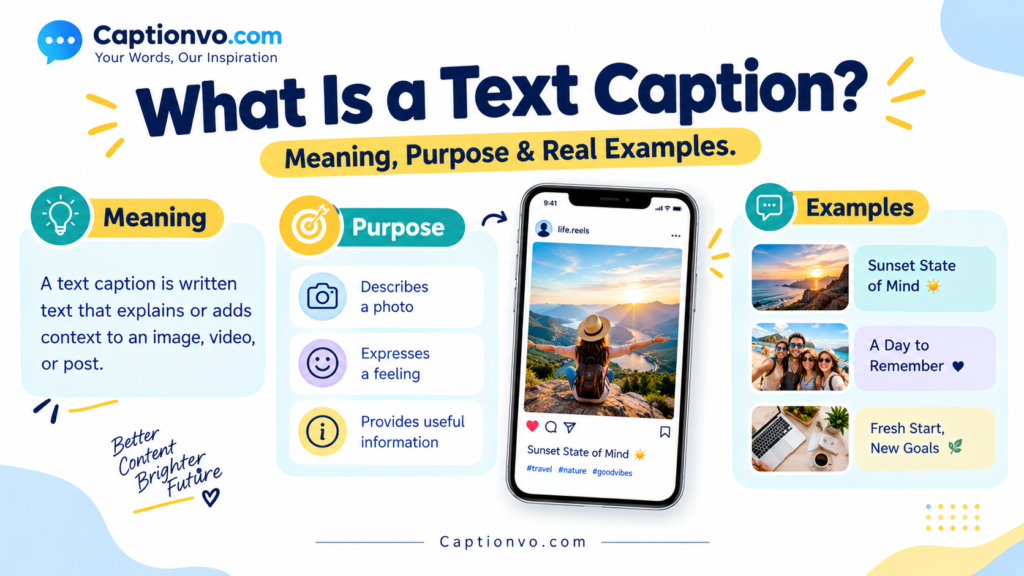
A text caption is written text that accompanies or appears with an image, video, graphic, chart, or social media post to describe it, add context, communicate a message, or help people understand the content. Its purpose depends on where it appears.
For example, “A quiet morning by the lake” describes a photograph, while “Progress starts with one small step” expresses an idea. Both can work as text captions in the right context.
In this guide, you will learn what text captions mean, explore 225 examples across 15 categories, and discover how to choose words that suit your photo, platform, audience, and personal style. You will also learn the difference between social media captions, image captions, video captions, subtitles, and alt text.
1. What Is a Text Caption? Meaning, Definition, and 15 Simple Examples
A text caption is a piece of writing associated with visual or multimedia content. It may explain what an image shows, communicate a feeling, provide important facts, or introduce a video or social media post.
The meaning changes slightly by context. A caption beneath a photograph often describes the image, while a caption accompanying an Instagram post might communicate the creator’s personality or tell the story behind the moment.
Here are 15 simple examples to illustrate how captions work:
- A little moment worth remembering.
- The story behind today’s smile.
- Sunshine through my window.
- A peaceful end to a busy day.
- One photograph, countless memories.
- Finding happiness in unexpected places.
- Today, in a few favorite moments.
- A small step toward something meaningful.
- Where the afternoon took us.
- A memory I wanted to keep.
- The beauty of an ordinary day.
- My favorite part of the journey.
- A moment that felt like home.
- Life lately, one frame at a time.
- A little reminder to slow down.
Best use: Everyday photographs, casual social media updates, personal blogs, and visual posts that need a little context.
Why they work: These examples show that a caption does not have to be complicated. It simply needs to support the content or communicate an idea that the image alone may not express.
2. What Is a Simple Text Caption? 15 Everyday Examples
A simple text caption communicates one clear thought without unnecessary detail. It is particularly useful when a photo already tells most of the story and you want the wording to feel natural.
Simple captions can express happiness, gratitude, confidence, or an everyday observation. They suit casual audiences and work well on Instagram, Facebook, WhatsApp Status, and personal photo albums.
- Keeping today simple.
- A good day, honestly.
- Little things, big smiles.
- Here for this moment.
- Just another beautiful memory.
- Taking life one day at a time.
- More moments like this, please.
- Happy to be here.
- Nothing fancy, just life.
- A day well spent.
- Making time for what matters.
- This felt worth sharing.
- A little pause in the rush.
- Grateful for the everyday.
- One of those days to keep.
Best use: Everyday updates, family photographs, casual selfies, and posts for friends or followers who prefer straightforward language.
Selection tip: Choose the line that adds a useful feeling or context. If the image already communicates everything clearly, a few words may be enough.
3. What Are Good Short Text Captions for Photos? 15 Examples
Short captions are quick to read and keep the focus on the image. They can contain a single word, a short phrase, or a compact sentence that captures a feeling.
They work particularly well for selfies, minimalist photography, Stories, and pictures where the visual itself carries most of the message.
- Unhurried.
- Golden state.
- Just blooming.
- Soft focus.
- Still becoming.
- Here, fully.
- Little wonders.
- Calm looks good.
- Fresh chapter.
- Unscripted joy.
- Present tense.
- Mood: outdoors.
- Quiet confidence.
- Purely present.
- My kind of magic.
Best use: Selfies, portraits, nature photos, fashion pictures, Snapchat Stories, and clean visual layouts.
Why they work: Their brevity helps the photograph remain the main attraction. However, a short caption should not replace important information when viewers need context or instructions.
4. What Are Funny Text Captions? 15 Witty Examples
Funny captions add a playful twist to ordinary experiences. They work best when the humor matches the photograph, the creator’s personality, and the audience’s sense of fun.
Use them for silly selfies, friendship pictures, pets, food photos, and everyday situations that people recognize.
- My productivity left the group chat.
- Looking responsible is half the battle.
- I had a plan. Then I got distracted.
- Powered by snacks and optimism.
- My camera roll deserves a comedy award.
- Currently buffering like slow internet.
- I dressed up to meet my own expectations.
- Adulting is a subscription I forgot to cancel.
- The outfit is ready; the life plan is pending.
- I take my naps very seriously.
- My weekend goals include zero unnecessary goals.
- I need a personal assistant for my personal decisions.
- The plot is confusing, but the lighting is great.
- Being on time is a beautiful theory.
- I came for one snack and left with a life lesson.
Best use: Casual Instagram posts, TikTok videos, Facebook updates, and Snapchat Stories.
Why they work: Relatable humor gives readers an easy way to connect with the situation. Keep the joke relevant and avoid humor that could embarrass someone or undermine a serious topic.
5. What Are Cute Text Captions? 15 Sweet Examples
Cute captions give photos a warm, cheerful, playful, or affectionate tone. They are especially suitable when the image communicates happiness, friendship, pets, little celebrations, or a sweet everyday moment.
The best cute captions feel personal rather than overly sentimental.
- A pocket-sized piece of happiness.
- Smiles are my favorite accessory.
- Tiny moments, happy heart.
- Sprinkling a little sweetness everywhere.
- My day just got cuter.
- Happiness looks good in this frame.
- Collecting smiles like little treasures.
- A soft spot for sunny afternoons.
- Made of giggles and good memories.
- Just a little bundle of joy.
- Keeping this one close to my heart.
- Sweet moments deserve their own spotlight.
- A happy heart changes the whole picture.
- Too many good things to fit in one photo.
- Sending a little sunshine your way.
Best use: Cute selfies, pet photos, friendship posts, family albums, and cheerful lifestyle content.
Emotional angle: These captions communicate warmth and approachability. Match the wording to the photograph instead of using a sweet tone for content that is serious or formal.
6. What Are Romantic and Love Text Captions? 15 Examples
Romantic captions express affection, appreciation, and the value of shared experiences. They can accompany couple selfies, anniversary photos, wedding moments, date nights, or small memories with someone special.
Specific, sincere wording often feels more personal than a dramatic statement about perfect love.
- My favorite place is wherever we are together.
- Ordinary days feel special with you.
- Our story grows in the smallest moments.
- You make the familiar feel magical.
- A thousand memories, and I still want more.
- My favorite notification is your name.
- Love is finding laughter in the everyday.
- Every shared sunset feels a little different.
- We make a pretty good team.
- Your hand makes every journey feel easier.
- The little things with you are the big things.
- One photo cannot hold everything I feel.
- My heart recognizes its favorite person.
- Here’s to the memories we’re still making.
- Somehow, life feels softer beside you.
Best use: Couple portraits, anniversaries, Valentine’s Day posts, wedding photographs, and relationship milestones.
Selection tip: A shared joke, a meaningful place, or a small detail from your relationship can make a romantic caption more authentic than a generic declaration.
7. What Are Attitude and Savage Text Captions for Selfies? 15 Examples
Attitude captions communicate self-confidence, independence, personal standards, and individuality. Savage captions often add a sharper or more humorous edge, but confidence does not require putting other people down.
These examples fit bold portraits, fashion photographs, achievement posts, and selfies with a self-assured tone.
- My lane, my pace, my rules.
- I stopped shrinking to fit the frame.
- Confidence, without the announcement.
- Not everyone’s favorite, and perfectly fine.
- My peace is no longer negotiable.
- Less proving, more improving.
- The standards changed when I did.
- I bring my own energy to the room.
- Unbothered by things I cannot control.
- I am the work in progress and the reward.
- No competition when the goal is growth.
- A different mindset changes the whole picture.
- My boundaries speak louder than my captions.
- Built on self-respect, not outside approval.
- I know my worth without the price tag.
Best use: Selfies, personal-brand profiles, fashion content, confidence posts, and personal milestones.
Audience fit: These captions appeal to readers who prefer direct and self-assured language. For professional branding, choose confidence over hostility.
More to Explore: https://captionvo.com/what-is-a-caption-word/
8. What Are Aesthetic and Mood-Based Text Captions? 15 Examples
Aesthetic captions emphasize atmosphere, color, light, texture, and subtle emotion. They work particularly well when the image has a distinctive visual style or when the creator wants a calm, artistic, dreamy, or minimalist voice.
Choose words that reflect what viewers can see and what the moment felt like.
- Afternoon light, a slower mind.
- Somewhere between a daydream and a memory.
- The sky painted what words couldn’t.
- A little stillness in a moving world.
- Dressed in the colors of today.
- Soft light, strong memories.
- Letting ordinary moments look extraordinary.
- The kind of quiet that stays with you.
- A frame full of atmosphere.
- When the colors say enough.
- Nothing loud, everything meaningful.
- A slow scene from a fast life.
- Collecting shades of serenity.
- Beautifully unfinished, perfectly present.
- Somewhere the world feels a little softer.
Best use: Sunset photography, fashion shoots, nature, architecture, travel journals, and Pinterest-style inspiration.
Why they work: The wording extends the visual atmosphere without competing with it. If the photo is energetic or funny, a playful caption may work better than a dreamy one.
9. What Are Deep and Emotional Text Captions? 15 Examples
Deep captions express reflection, change, vulnerability, gratitude, and personal growth. They suit life updates and meaningful experiences that need more than a literal description.
Use honest language and connect the words to something real. Emotional captions are most effective when they leave room for the reader to interpret the moment.
- Some chapters teach you before they reward you.
- I am learning to appreciate the person I am becoming.
- Not every quiet season means nothing is growing.
- Some goodbyes make room for a better understanding of yourself.
- Healing is not always visible in a photograph.
- The hardest lessons often change the way we see everything.
- I carry the memories without living inside them.
- Growth sometimes begins with an uncomfortable truth.
- A peaceful heart is a kind of success.
- Some moments matter because of what they helped me realize.
- I am no longer measuring life by someone else’s timeline.
- Even the unfinished parts belong to my story.
- Gratitude makes familiar things feel new again.
- The person behind the smile has grown a lot.
- I am learning that moving forward can be gentle.
Best use: Personal milestones, reflective portraits, graduation posts, year-end recaps, and meaningful life updates.
Emotional angle: These captions invite reflection without claiming that a photo reveals everything about someone’s life.

10. What Are Inspirational and Motivational Text Captions? 15 Examples
Motivational captions are useful for sharing progress, celebrating achievements, encouraging friends, or documenting the work behind a goal.
Instead of promising instant success, choose language that recognizes effort, learning, consistency, and realistic progress.
- Start where you are; build from there.
- Small actions are still actions.
- Your next attempt can teach you something new.
- Progress is allowed to look imperfect.
- Keep the promise you made to yourself.
- Courage can be quiet and still be powerful.
- Every skill begins with a beginner’s step.
- Consistency gives small efforts a direction.
- Let the work speak at its own pace.
- Today’s effort becomes tomorrow’s experience.
- You can change the plan without abandoning the goal.
- Celebrate the discipline nobody else sees.
- A slow beginning is still a beginning.
- Keep learning beyond the applause.
- Make room for effort, rest, and another try.
Best use: Study achievements, fitness journeys, graduation, business milestones, creative work, and personal development posts.
Audience fit: These lines work well for people who want encouragement without exaggerated promises. Add a real detail about the achievement to make the caption more personal.
11. What Are Instagram and Selfie Text Captions? 15 Examples
Instagram Captions can add personal context to a single photo, explain a carousel, or give a Reel a clear introduction. Selfie captions also play a role in personal branding because they communicate tone and personality alongside the image.
Strong captions do not need to sound like an advertisement. They should reflect your voice and give followers a reason to understand the moment. Hootsuite’s overview describes social media captions as accompanying text that can help tell a post’s story.
Hootsuite’s Glossary of Social Media Terms
- A little update from my side of the world.
- Today’s favorite frame, saved for later.
- The camera caught the smile; the day gave me the reason.
- Current chapter: making more time for myself.
- A familiar face with a few new perspectives.
- This is your reminder that life happens off-screen, too.
- A few frames from the days I want to remember.
- My style changes; my curiosity stays.
- Posting the moment, keeping the feeling.
- Here for the memories, learning along the way.
- A candid reminder to enjoy the process.
- The little details made this day.
- A snapshot of what matters to me right now.
- More authenticity, less performance.
- This version of me has a story of its own.
Best use: Instagram feeds, selfies, personal-brand posts, creator updates, and photo carousels.
Platform tip: The first line should establish the subject or feeling clearly. For longer captions, put the most useful information early so readers can understand the post without reading a long introduction.
12. What Are TikTok and Reels Text Captions? 15 Examples
Captions accompanying short-form videos can introduce a tutorial, explain what is happening, set expectations, or invite a relevant response. They should complement the video rather than promise a result the video does not deliver.
These examples are for the written social post, not synchronized accessibility captions.
- The small detail that changed the whole result.
- Here’s what happened between the before and after.
- Trying the idea I’ve saved for months.
- Three steps, one much simpler process.
- The ending makes the setup worth it.
- A behind-the-scenes moment I nearly forgot to film.
- Watch the process, then decide which version you prefer.
- This was my first attempt, not my final word.
- A quick tutorial for your next creative session.
- What would you change about this result?
- A realistic look at how this came together.
- The detail I wish I had noticed sooner.
- Testing a new approach and sharing what I learn.
- Save this for the next time you need the steps.
- One small experiment, a surprisingly useful lesson.
Best use: TikTok, Instagram Reels, Facebook Reels, tutorials, demonstrations, before-and-after videos, and behind-the-scenes clips.
Why they work: Each caption makes the video’s subject or intended takeaway clearer. Curiosity can help attract attention, but the video should deliver what the caption suggests.
For video accessibility, a separate synchronized caption track may be needed so viewers can follow important speech and audio information. This is explained in more detail below, following W3C guidance.
More to Explore: https://captionvo.com/savage-captions-75-that-say-it-without-saying-much/
13. What Are Facebook, WhatsApp, and Snapchat Text Captions? 15 Examples
Captions for status updates and everyday sharing often work best when they sound conversational. A message for close friends may be more relaxed than a public announcement, so choose wording that suits who can see your post.
- A little life update from today.
- Taking a break and enjoying the view.
- One good reason to smile this week.
- Nothing major, just a moment I liked.
- Sharing this before the day gets away from me.
- A good memory from a regular day.
- Some sunshine for your timeline.
- Today’s plan: enjoy the small things.
- A quick hello from my corner of the world.
- The weekend started on a good note.
- A little progress worth celebrating.
- Saving this moment before it becomes a memory.
- Sending good wishes to everyone reading this.
- A fresh day and a fresh perspective.
- Here is the part of today I’d like to keep.
Best use: WhatsApp Status, Snapchat Stories, Facebook personal updates, family photos, and casual sharing.
Platform tip: Consider privacy and audience before posting. A personal status for close friends may need less explanation than a public post viewed by people who do not know the background.
14. What Are Travel, Friends, and Lifestyle Text Captions? 15 Examples
Travel and lifestyle captions help readers understand the experience behind a picture. They can highlight a destination, the people involved, a memorable detail, or the feeling of being somewhere new.
Use these for holidays, road trips, food outings, group photographs, weekend adventures, and lifestyle updates.
- Took the longer route and found the better view.
- New streets, familiar laughter.
- A day measured in memories rather than miles.
- The best part of the trip was who came along.
- Collecting little stories from unfamiliar places.
- Good food, long conversations, no rush.
- Friends who make the ordinary feel like an occasion.
- Somewhere new, feeling more present.
- The map chose the road; curiosity chose the stops.
- This view deserves more than a camera roll.
- A weekend full of small, happy surprises.
- We came for the destination and stayed for the moments.
- The best souvenirs are the stories we bring home.
- A table full of food and people worth keeping close.
- Leaving with tired feet and a full heart.
Best use: Travel photography, friend-group pictures, food outings, weekend recaps, lifestyle blogs, and destination posts.
Selection tip: Add a real location, activity, or memorable detail when readers would benefit from the context. A specific detail often makes a caption more distinctive.
15. What Are Business, Educational, and Informative Text Captions? 15 Examples
Business and educational captions need to do more than sound attractive. They should explain the subject, identify the practical value, or help the reader understand an image, chart, product, lesson, or announcement.
For professional posts, accuracy and clarity matter more than clever wording. Use the following examples as starting points and replace general details with verified information.
- Meet the new addition to our collection, designed for everyday use.
- Here are three practical steps to improve your next project.
- Behind today’s result is a process of testing and refinement.
- Our team is sharing what we learned from this week’s workshop.
- This diagram summarizes the main stages of the process.
- A closer look at the features that make this product useful.
- Students present their findings at the annual research exhibition.
- Figure 1 shows the change in survey responses across the study period.
- Learn how the process works before choosing the approach that fits you.
- Our newest update addresses the questions customers asked most often.
- This week’s lesson explains the difference between a caption and alt text.
- The photograph documents volunteers preparing the community garden.
- Registration details and deadlines are included in the announcement.
- This example demonstrates how a short caption can add important context.
- Explore the guide to understand the process, compare your options, and plan your next step.
Best use: Business social posts, educational graphics, product launches, blog photographs, research figures, project updates, and professional profiles.
Audience fit: Customers need useful information; students need explanation; researchers and news readers need accurate context. Adapt the caption to what that audience needs to understand.
Part 5. What Is the Purpose of a Text Caption?
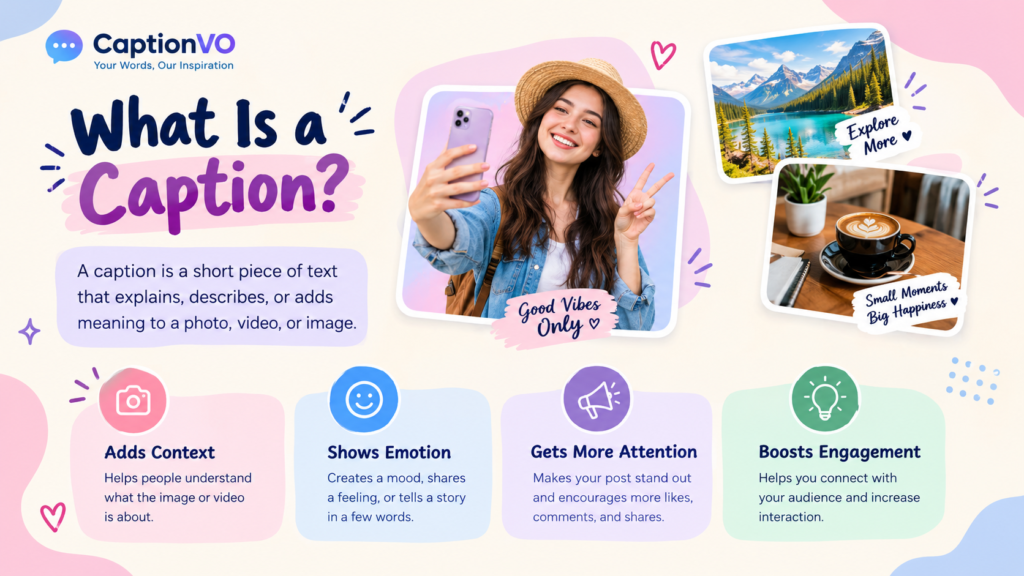
The purpose of a text caption is to help an audience understand, interpret, or respond to content. A caption may provide information, express emotion, or make a post easier to follow.
The most useful captions usually serve one clear purpose.
To describe: Identify what an image shows. Example: “A narrow street lined with traditional houses.”
To provide context: Explain why a moment matters. Example: “The first family trip we had planned together in years.”
To express personality: Share a thought or feeling. Example: “A little more confidence, a little less overthinking.”
To inform: Summarize a lesson, event, or finding. Example: “The workshop introduces beginners to the basics of digital photography.”
To promote: Explain an offer, product, or service. Example: “Explore our new everyday collection, designed with comfort in mind.”
To encourage conversation: Invite a relevant response. Example: “Which of these designs would you choose?”
Captions should not always be written to generate likes or comments. A factual description, an educational explanation, or a quiet personal statement may accomplish its purpose without any call to action.
Part 6. What Are the Different Types of Text Captions?
The same photograph can use different captions depending on its purpose and audience.
| Caption type | Main purpose | Suitable example |
| Descriptive | Explain visible content | “A cyclist crosses the bridge at sunrise.” |
| Informative | Provide facts or context | “The exhibition opens to the public on Monday.” |
| Creative | Add personality or imagery | “The afternoon arrived wearing gold.” |
| Funny | Communicate humor | “My to-do list is learning patience.” |
| Emotional | Express a personal feeling | “Some memories become part of who we are.” |
| Promotional | Introduce a product or service | “Discover the newest addition to our collection.” |
| Educational | Explain a concept | “A caption adds context; alt text describes an image’s relevant information or function.” |
| Social media | Accompany a personal or public post | “A few moments from a day well spent.” |
| Figure caption | Identify a chart or diagram | “Figure 1: Monthly changes in survey participation.” |
| Video accessibility caption | Represent speech and meaningful sounds in synchronized text | “[Door opens] Welcome back!” |
Some of these categories overlap. An Instagram caption can also be funny, descriptive, or promotional. The category describes the caption’s purpose rather than a fixed format.
More to Explore: https://captionvo.com/how-do-i-caption-myself/
Part 7. How to Write a Good Text Caption in 5 Steps
You can write an effective caption without relying on complicated writing techniques. Follow this five-step process.
Step 1: Identify the content
Look at the photo, video, graphic, or post. Identify its main subject and the information the audience should understand.
For example, a graduation photograph might communicate achievement, gratitude, or the beginning of a new chapter.
Step 2: Decide on the message
Ask yourself what you want readers to understand or feel.
For a graduation photograph, you might want to thank your family rather than simply announce that you graduated.
Step 3: Match the audience and tone
Use casual language for informal personal posts and precise wording for academic, journalistic, or professional content.
An audience of close friends may appreciate a playful joke. Readers viewing an educational chart need a clear, accurate explanation.
Step 4: Write and refine your first draft
Start with one sentence and add specific context when needed.
Basic version: “I graduated today.”
Improved version: “Graduation day is here, and I am grateful to everyone who helped me reach this milestone.”
The improved version communicates both the event and the feeling behind it.
Step 5: Review before publishing
Check that the caption matches the content, reads naturally, and contains accurate information. Remove unnecessary wording and add a question or call to action only when it makes sense.
A useful formula to remember is:
Purpose
What should the caption accomplish?
Context
What does the audience need to know?
Voice
What tone sounds appropriate?
Optional next step
Should the reader respond, learn more, or take action?
Not every caption needs all four components. A one-word caption may be sufficient for a simple photograph, while a business announcement may need context and a next step.
Part 8. How to Choose the Best Text Caption for Your Post
When several captions seem appropriate, choose based on the content and the response you want to encourage.
| Your content | Best starting point | Why |
| Selfie or Portrait | Short, confident, or personal | Adds personality without distracting from the image |
| Sunset or scenery | Aesthetic or reflective | Complements the visual atmosphere |
| Friends or family | Warm, funny, or affectionate | Emphasizes relationships and shared memories |
| Travel photo | Descriptive or adventurous | Adds the destination or experience behind the image |
| Tutorial or demonstration | Informative and specific | Sets expectations and clarifies the takeaway |
| Product photograph | Benefit-focused and factual | Helps potential customers understand its value |
| Research figure | Precise and descriptive | Makes the figure easier to interpret |
| Video with speech | A clear post caption plus synchronized accessibility captions where needed | Supports discovery and audio accessibility in different ways |
Which captions are most engaging?
There is no single caption style that consistently works best for every audience. A funny caption may fit an entertaining video, whereas a clear explanation may be more useful for an educational post.
For stronger communication, make the caption relevant to the content, use a tone your audience recognizes, and avoid exaggerated promises. Platform guidance from Meta also emphasizes using captions to add context, support storytelling, and encourage appropriate actions.
How can you make a caption feel more original?
Include a detail that is specific to the actual experience. Instead of writing “Best day ever,” mention the little moment that made the day memorable.
For example:
- Generic: “Amazing trip.”
- More specific: “We missed the first train, found a tiny café, and somehow made the day even better.”
The second example gives the audience a clearer story and feels less interchangeable with thousands of other posts.
The same text is not automatically appropriate for both purposes. For example, a poetic social caption may express the mood of a photograph without identifying its important visual details. Alt text should instead convey the information or function that matters in that context.
Part 10. What Are Video Captions? Types, Examples, and Uses
The phrase video captions has two common meanings.
Social media captions are the written descriptions that accompany video posts. They introduce a topic, explain what viewers will learn, provide context, or invite a response.
Example: “Follow these three steps to prepare your workspace before the project begins.”
Accessibility captions are synchronized text representing speech and relevant non-speech audio. They can identify speakers and communicate meaningful sounds, helping viewers follow audio information through text.
Example:
[Door opens]
Maya: Are you ready to begin?
[Music starts]
W3C explains that accessibility captions should represent the speech and non-speech audio information needed to understand a video. Open captions remain visible in the video, whereas closed captions can generally be turned on or off in a compatible player.
| Feature | Social media post caption | Accessibility caption |
| Main purpose | Provide context or communicate a message | Represent relevant audio information |
| Typical format | Text accompanying a post | Synchronized text in the video player or video |
| Example | “Watch the complete tutorial.” | “Welcome back!” synchronized with the speaker |
| Main consideration | Relevance, clarity, and audience | Accuracy, timing, and accessible presentation |
These formats can complement each other. A video might have a short written description for the social post and a separate, accurate caption track for its dialogue and meaningful sounds.
Part 11. Text Caption Tips for Instagram, TikTok, Facebook, and Other Platforms
Different platforms and formats create different expectations, but the same basic principle applies: make the caption useful for the content and audience.
| Platform or format | Recommended approach |
| Instagram posts | Give context, use a recognizable voice, and consider whether a short or longer caption suits the photo |
| Instagram Reels | Introduce the video clearly and avoid promising a result that the video does not deliver |
| TikTok | Explain the clip’s topic or main takeaway, especially for tutorials and demonstrations |
| Match the caption to whether the post is a personal update, community announcement, or business message | |
| WhatsApp Status | Keep personal updates natural and appropriate for the intended audience |
| Snapchat Stories | Use concise wording that works with the image or clip |
| Write descriptive wording that helps viewers understand the subject of the pin | |
| Business and professional profiles | Highlight relevant information, maintain credibility, and use an appropriate call to action |
Platform interfaces, publishing options, and display limits can change. Check the current publishing interface when planning a campaign, especially when working with character limits, hashtags, or accessibility features.
Do not assume that one style works everywhere. A short phrase may complement a selfie, while a tutorial might need a useful explanation and a clear next step.
Part 12. Common Text Caption Mistakes to Avoid
Even an interesting caption can be less effective when the wording does not fit the content.
1. Describing only what is obvious. “A cup of coffee” may add little to a clear photograph. A personal detail such as “My quiet start to a busy Monday” may provide more context, although a literal description can be appropriate in factual settings.
2. Making every caption sound the same. Repeating generic phrases makes posts feel interchangeable. Use a detail, observation, or feeling specific to the moment.
3. Writing too much without a purpose. Longer captions can tell meaningful stories, but unnecessary sentences make the main point harder to find.
4. Forcing a trend or a joke. Trend-aware language can be useful when it fits your voice, but copying a popular expression may feel unnatural when it does not match the content.
5. Adding irrelevant hashtags. Choose topic-related hashtags where appropriate instead of adding unrelated tags.
6. Asking for engagement on every post. Questions and calls to action should be relevant. Not every photograph needs to ask readers to comment, save, or share.
7. Publishing inaccurate facts. Verify the names, dates, locations, statistics, product claims, and other details in informational captions.
8. Confusing captions with alt text. A visible caption does not automatically provide the text alternative an image needs. Consider accessibility separately when publishing visual content.
9. Assuming a caption guarantees reach. No particular phrase or format guarantees virality, engagement, or a higher search ranking. Focus on clarity, relevance, and the audience’s actual needs.
People Also Ask About Text Captions
A: A text caption is written text that accompanies an image, video, or other content to describe it, provide context, express a feeling, or communicate information.
A: For a sunset photograph, “A quiet ending to a beautiful day” is a text caption. It communicates the atmosphere of the moment rather than simply naming the object in the picture.
A: Its purpose is to help an audience understand or connect with the content. Depending on the context, a caption can describe an image, tell a story, explain information, or encourage an appropriate response.
A: Five useful qualities are relevance, clarity, accuracy, an appropriate tone, and a clear purpose. Not every caption needs to be entertaining or invite engagement.
A: There is no universal ideal length. Use a few words when the visual already communicates the message, and use more detail when readers need context, instructions, or an explanation.
Conclusion
A Text Caption can do much more than label a photograph. It can express a feeling, explain a visual, provide context, introduce a video, or help an audience understand an important point.
The best caption depends on the content and the person reading it. A short phrase may suit a selfie, a personal story may work for a travel photograph, and a precise description may be better for a chart or educational graphic











2 thoughts on “Text Caption Meaning: 225 Examples & Writing Tips”