Reply for Take Care of Yourself: 225+ Best Responses for Every Situation
Someone just told you to “Take Care of Yourself“—but what should you say back? A simple “you too” works, yet the right response can feel warmer, funnier, more romantic, or more professional depending on who sent the message. Whether it came from a close friend, your crush, a partner, a colleague, or someone saying goodbye, you deserve words that sound genuinely natural and fit the moment. This guide brings together ready-to-send replies for every situation, from short text messages to heartfelt responses and polite goodbyes. Choose a message that matches your relationship, express your appreciation, and keep the conversation comfortable.
The best response depends on who sent the message and why they said it. A close friend might appreciate a playful answer, while a romantic partner may prefer something affectionate. A colleague or teacher, on the other hand, usually deserves a polite response.
In this guide, you’ll find 225 ready-to-send replies for everyday conversations, WhatsApp messages, Instagram DMs, romantic chats, professional situations, and meaningful goodbyes. You’ll also learn what the phrase means, how to choose the right response, and how to keep a conversation going.
What Is the Best Reply to Take Care of Yourself?
The best all-purpose response is:
“Thank you, I will. You take care of yourself too!”
It sounds natural, expresses appreciation, and returns the sender’s good wishes. You can use it with friends, family members, colleagues, acquaintances, and almost anyone who sends you a thoughtful message.
Here are some other excellent responses for different situations:
| Situation | Best response |
| Everyday conversation | Thanks! You too. |
| Close friend | Appreciate you looking out for me. |
| Romantic partner | I will, my love. You take care too. |
| Crush | I will, especially when you remind me so sweetly. |
| Professional conversation | Thank you. I appreciate your concern. |
| Difficult time | Thank you. That means more than you know. |
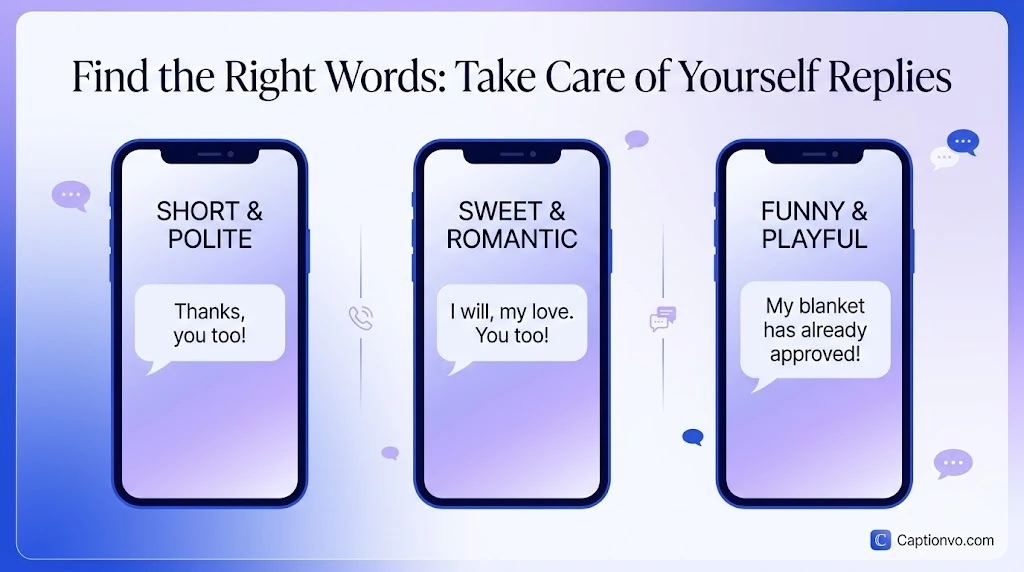
| Funny conversation | I will, my blanket has a plan for me. |
| Someone saying goodbye | Thank you. Wishing you all the best too. |
| Travel or journey | I will. I’ll message you when I arrive. |
| Someone you no longer talk to | Thank you. I wish you well too. |
You do not need an elaborate sentence every time. A short, sincere response is often more effective than a complicated one.
What Does Take Care of Yourself Mean?
“Take care of yourself” is a common English expression used to show concern, affection, kindness, or good wishes. It generally means that someone hopes you remain safe, healthy, and well.
However, the meaning can change depending on the relationship and circumstances.
1. Genuine concern: Someone may use it after learning that you are sick, stressed, tired, or dealing with a difficult situation.
2. A friendly goodbye: Friends, colleagues, and acquaintances often use it when ending a conversation or saying goodbye.
3. Romantic affection: A partner or crush might use it to show that your happiness and well-being matter to them.
4. Emotional support: Someone may say it when they know you are going through a challenging period and want to offer encouragement.
5. A respectful farewell: It can also be a kind way to end communication, particularly when people are moving in different directions.
Remember that “take care of yourself” does not automatically indicate romantic interest. The relationship, timing, conversation, and sender’s tone help you understand the intended meaning.
1. Simple and Polite Replies to Take Care of Yourself
A simple and polite response is perfect when someone is being thoughtful without making the conversation overly personal. These replies are suitable for acquaintances, neighbors, classmates, and everyday conversations.
- Thanks for the reminder. I will.
- I appreciate that. Take care too.
- Thank you, and I hope you stay well.
- Certainly. Wishing you a peaceful day.
- That’s kind of you. I’ll do that.
- I will. Thanks for your good wishes.
- Thank you for thinking of me.
- I’ll keep that in mind. Same to you.
- Thanks. Please look after yourself too.
- I appreciate your concern.
- Of course. Have a lovely day.
- Thank you. Wishing you all the best.
- I will, and I hope everything goes well for you.
- Thanks for saying that. Stay well.
- Likewise. Take care!
Best for: Casual conversations, acquaintances, and polite goodbyes. These responses are particularly useful when you want to acknowledge someone’s kindness without extending the conversation.
2. Short Replies to Take Care of Yourself for Text Messages
Sometimes, a quick message is all you need. Short replies work especially well on WhatsApp, Instagram DMs, Facebook Messenger, Snapchat, and ordinary SMS conversations.
- You too!
- Will do 🙂
- Right back at you.
- Same to you!
- Thanks, I will.
- Likewise.
- Always. You too.
- Appreciate it!
- You stay safe too.
- Got you, thanks.
- Take care as well.
- Sure thing!
- Thanks, same wishes.
- I’ll be careful.
- Catch you later. Stay well!
Best for: Quick conversations, casual messages, and people you already know well. Add an emoji only when it matches your usual texting style.
3. Warm and Friendly Replies to Take Care of Yourself
A warm reply makes the other person feel appreciated. These messages are suitable for friends, classmates, neighbors, and people who regularly check on you.
- Thanks for always checking on me.
- That was thoughtful of you.
- I hope you receive the same kindness back.
- Your message put a smile on my face.
- I’ll do that. Don’t forget yourself.
- Thanks for being someone I can count on.
- Wishing you calm days and good health too.
- I’m glad we can look out for each other.
- That means a lot, friend.
- Take good care; you deserve it too.
- Thanks for keeping me in your thoughts.
- Sending a little kindness your way.
- I hope your week treats you gently.
- I’ll remember your advice.
- Let’s both make time to rest.
Best for: Friends and people with whom you share a comfortable relationship. A warm response returns the kindness without sounding overly formal or romantic.
4. Heartfelt and Emotional Replies to Take Care of Yourself
Sometimes, a simple message arrives when you need emotional support the most. When someone shows genuine concern, a heartfelt response can communicate how much their words mean to you.
- I needed that reminder more than you know.
- Thank you for caring when I haven’t felt like myself.
- Your words made a difficult day feel lighter.
- I’m learning to be kinder to myself. Thank you.
- It helps to know I’m not forgotten.
- I won’t take your kindness for granted.
- Thank you for noticing when I need a little support.
- I’ll take things slowly, one day at a time.
- Your message reached me at just the right moment.
- I hope you receive the same care you give others.
- I appreciate you being gentle with me.
- I’ll try to give myself the patience you showed me.
- It means a lot that you took the time to say that.
- Thanks for reminding me that I deserve care too.
- I wish you peace and strength in return.
Best for: Difficult days, emotional conversations, and people who have supported you through personal challenges. Use a response that reflects how you genuinely feel rather than choosing one simply because it sounds impressive.
More to Explore: https://captionvo.com/success-bio-for-instagram-2/
5. Funny Replies to Take Care of Yourself
Want to make someone laugh while responding to their thoughtful message? A little humor can turn an ordinary goodbye into a memorable conversation.
- I’ll try, but my cat thinks I’m its full-time staff.
- Self-care committee has approved an early bedtime.
- Copy that. Hydration levels are under review.
- I will. My snacks have already filed a support plan.
- My couch and I are working on it.
- Don’t worry, I’m on a strict schedule of naps and optimism.
- I’ll take care, pending approval from my blanket.
- I plan to avoid drama and low phone batteries.
- Sure. I’m treating rest like an important appointment.
- I’ll try not to fight my sleep schedule tonight.
- Thank you. My plants are holding me accountable.
- I’m putting “look after myself” on the to-do list, in bold.
- I’ll be careful. I have unfinished episodes to watch.
- I will, as soon as my coffee stops being my personality.
- Deal, but you have to stop skipping lunch too.
Best for: Friends, siblings, and people who appreciate your sense of humor. Avoid joking when someone is genuinely worried or discussing a serious situation.
6. Cute and Sweet Replies to Take Care of Yourself
Sometimes you want your response to sound adorable, affectionate, and positive without becoming too romantic. These sweet messages are suitable for close friends and someone who makes your day brighter.
- Aww, I will. You promise to do the same?
- That’s a sweet little reminder.
- I will, sending a pocketful of good wishes back.
- You’re lovely for thinking of me.
- Okay, but only if you stay happy too.
- This message deserves a smiley face and a hug.
- I will, you gentle soul.
- Thanks for being a bright spot in my day.
- I’ll keep safe. Pinky promise!
- Right back at you, lovely human.
- You made my day a bit softer.
- I hope something makes you smile today too.
- Consider a warm hug sent your way.
- You’re too kind. Please be kind to yourself too.
- I will, and I’m saving your message for a rainy day.
Best for: Close friendships, affectionate conversations, and lighthearted messages. Choose a sweet reply when you want to make the sender feel appreciated.
7. Flirty Replies to Take Care of Yourself From a Crush
When your crush says “take care of yourself,” you might want to express a little interest without sounding too serious. The best flirty messages feel playful, natural, and confident.
- I will, especially with you checking in.
- Does this mean I get another message from you later?
- I might need a reminder from you tomorrow.
- You make even a goodbye sound sweet.
- I’ll take care; you have my attention now.
- Should I take that as an invitation to see you soon?
- I’m smiling more than I should at this message.
- I will, but your company would make it easier.
- That’s a dangerous amount of sweetness from you.
- I’ll stay out of trouble if you keep texting me.
- You checking on me might become my favorite habit.
- Now I have a reason to look forward to your next text.
- I will. Can I return the favor over coffee?
- You’re making it hard to say goodbye.
- Only if you promise to let me know you’re okay too.
Best for: A crush, someone you are getting to know, or a conversation that already has a playful tone.
A good flirty Response Should invite connection without making the other person feel pressured. “I will, especially with you checking in” is an excellent balance of warmth and interest.
8. Romantic Replies to Take Care of Yourself for Your Partner
When your boyfriend, girlfriend, husband, or wife tells you to take care of yourself, you can respond with something loving and reassuring.
- I will, my love. Your peace matters to me too.
- I’ll stay well so we can enjoy more ordinary days together.
- Your care makes me feel loved even from far away.
- I promise to rest, sweetheart. I want you beside me for a long time.
- I will, and I’ll be thinking of you.
- Please look after your heart as carefully as you look after mine.
- I wish I could say that while holding your hand.
- I’ll be safe until the next time I see you.
- Thank you for loving me in these little ways.
- You are part of the reason I remember to slow down.
- I will, darling. Let me know when you get home too.
- Let’s make a promise to look after each other.
- Your message feels like a hug I can keep.
- I’ll take care of myself, and I want you to do the same for us.
- I love how you make even simple words feel special.
Best for: A committed relationship or someone with whom you already share romantic feelings. Personalize the response with a term of affection you normally use.
9. Best Replies to Take Care of Yourself From a Friend
Friendship often involves small reminders that show people care. When a friend sends this message, you can respond with appreciation, playful humor, or a plan to meet again.
- I will, mate. Someone has to keep our plans alive.
- Thanks for checking in. What’s the next adventure?
- You too; I need my favorite troublemaker in good shape.
- Got it. I’ll send proof when I’ve had actual lunch.
- Thanks, you’re a good one.
- I’ll do that. Don’t vanish on me.
- You take care too; we still have a catch-up pending.
- Appreciate you, especially on days like this.
- I’ll be fine. Save me a seat next time.
- Thanks for being the friend who remembers.
- Stay well, pal. Our group chat needs you.
- I’ll look after myself. You handle your chaos too.
- That means a lot. Let’s talk properly soon.
- Thanks, partner in questionable decisions.
- I will. Message me when you’re free.
Best for: Best friends, classmates, old friends, and group-chat conversations. A personal reference to a shared plan or inside joke can make your response feel more genuine.
More to Explore: https://captionvo.com/nauvari-saree-captions-in-marathi/
10. Replies to Take Care of Yourself From Family Members
When parents, siblings, grandparents, or other relatives say “take care of yourself,” their words usually come from genuine affection and concern.
A reassuring response helps them know you appreciate their care.
- I will, Mom. I’ll call you when I’m home.
- Thanks, Dad. I promise I’ll be careful.
- I will, and I’ll make sure to eat on time.
- Love you. Please take care of your health too.
- Don’t worry; I’ll let you know when I arrive.
- I’ll keep your advice close. Give everyone my love.
- Thank you for always looking out for me.
- I will. Please get some rest yourself.
- I’ll check in tonight so you know I’m safe.
- Your prayers and care mean everything to me.
- I promise to be mindful. How are you feeling?
- Sending love to you and everyone at home.
- I’ll stay in touch; no need to worry.
- Thank you for being my safe place.
- I will. I want you healthy and happy too.
Best for: Parents, siblings, grandparents, and relatives. When someone in your family is worried about you, a specific reassurance can mean more than a generic “you too.”
11. Professional Replies to Take Care of Yourself at Work
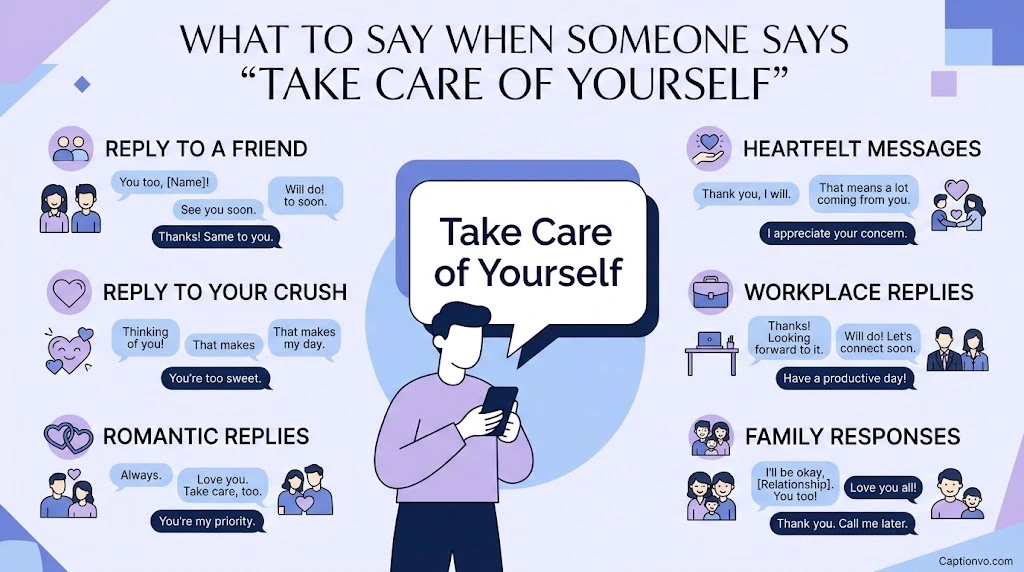
In professional communication, the best response is respectful, clear, and friendly without sounding overly familiar. These replies work for managers, colleagues, clients, teachers, and workplace contacts.
- Thank you for your consideration. I wish you well too.
- I appreciate your thoughtful message. Have a good day.
- Thank you. Please take care as well.
- I will. Thank you for checking in.
- Likewise, and I hope you have a restful weekend.
- Thank you for your support. I look forward to reconnecting.
- I appreciate it. Wishing you continued good health.
- Thanks for your understanding. Take care.
- I will. Safe travels, and speak soon.
- Thank you for the kind reminder. Enjoy the rest of your day.
- I appreciate your concern. Best wishes to you as well.
- Thank you. Please have a safe journey home.
- That’s considerate of you. I hope all goes well.
- Thank you for everything. It was a pleasure working with you.
- Certainly. Wishing you a productive and peaceful week.
A respectful response to a teacher or mentor
When a teacher or mentor sends you a caring message, you can use a respectful variation such as:
- Thank you, Professor. I really appreciate your concern.
- Thank you for your guidance. Please take care too.
- I appreciate your kindness and wish you continued success.
- Thank you, sir/ma’am. I’ll certainly take care.
- It has been a pleasure learning from you. Wishing you well.
Best for: Workplace messages, professional emails, teachers, and formal goodbyes. Use a more personal response only when you have an established friendly relationship with the sender.
12. Replies When Someone Says Take Care of Yourself Because You Are Sick or Stressed
When somebody knows that you are unwell, exhausted, or experiencing stress, their message may be a genuine attempt to support you.
An honest reply can acknowledge their concern without requiring you to share private details.
- Thanks. I’m giving myself time to recover.
- I appreciate the check-in; today has been a little heavy.
- I’m following the care plan and taking things slowly.
- Thank you. I’ll reach out if I need a hand.
- I’m resting where I can, and your message helps.
- That’s kind. I’ll try to step away from work tonight.
- I’m not fully back to normal, but I’m taking it day by day.
- Thanks for asking. A quiet evening should help.
- Your support makes this feel less overwhelming.
- I will. I’ll keep you posted after my appointment.
- Thanks. I’m trying not to push myself too hard.
- I appreciate you understanding that I need some downtime.
- I’ll focus on getting better. Thank you for being patient.
- It means a lot that you checked in.
- I will. I hope your own week is going smoothly.
Best for: Difficult periods, stressful workloads, recovery, and conversations with people who genuinely care. You can be appreciative without revealing information you would rather keep private.
13. Replies to Stay Safe and Take Care
“Stay Safe and Take Care” is commonly used before a trip, during travel, or when someone is worried about your safety.
A good response can reassure the sender that you will be careful and return their good wishes.
- I will. I’ll text you when I reach.
- Thanks. I’ll keep you updated along the way.
- You too; let me know when you’re back safely.
- I appreciate it. I’ll be careful on the road.
- I’ll keep my phone charged and stay in touch.
- Thanks for thinking ahead. Have a safe trip too.
- I’ll message after I land.
- Thanks. I’ll stick to the planned route.
- I will. Hope the weather is kind to your journey too.
- Take care until we meet again.
- I’ll check in once I’ve arrived at the hotel.
- Thanks for the reminder. Don’t rush on your way back.
- I will, and please share your arrival update too.
- Safe travels. Let’s both get there without a worry.
- Thanks. I’ll take the sensible precautions.
Best for: Road trips, flights, late-night travel, and journeys away from home. A reply such as “I’ll message you when I arrive” is especially useful when the sender is worried about your safe arrival.
14. Replies to Take Care of Yourself From an Ex or Someone You Are Distant From
When an ex-partner or someone you no longer communicate with regularly says “take care of yourself,” your response should reflect your boundaries and intentions.
You can be respectful without restarting a conversation or giving the impression that you want to reconnect.
- Thank you. I wish you well too.
- I appreciate the message. Take care.
- Thanks. I hope things go well for you.
- Wishing you peace and good things ahead.
- Thank you for saying that. All the best.
- I hear you. Please look after yourself too.
- I appreciate your concern, but I need to keep some distance.
- Thank you. I hope we both find a good way forward.
- I wish you well, even from a distance.
- Thanks for the memories. I hope life treats you kindly.
- I think it’s best we leave things here. Take care.
- I appreciate it, but I’m not looking to restart contact.
- Thank you. Please respect that I need space.
- I wish you happiness, but I won’t continue this conversation.
- Take care. I won’t be messaging further.
Best for: An ex, a former friend, or someone with whom you want to maintain distance. You are not obligated to respond if doing so would make you uncomfortable. A clear boundary can be kinder and healthier than sending a message that creates false expectations.
More to Explore: https://captionvo.com/rangoli-captions/
15. Replies That Keep the Conversation Going
Sometimes, you do not want “take care of yourself” to be the end of the conversation. The easiest way to continue chatting is to acknowledge the message and add a natural question.
- Thanks! How have you been lately?
- I will. What are you up to this weekend?
- Appreciate it. Did you get home alright?
- Thanks for checking in. How is your week going?
- You too! Are we still on for coffee?
- I will. How did your presentation go?
- Thanks. What have you been watching recently?
- I appreciate it. Want to catch up on a call later?
- You too. How is everything at your end?
- Thanks! Did you finish that project you mentioned?
- I will. When are you free to meet?
- That’s kind of you. How was your trip?
- Thanks for the reminder. Tell me how your interview went.
- I will. Is there anything new with you?
- You too. Let’s plan a proper catch-up soon.
Best for: Friends, crushes, colleagues, and anyone with whom you want to continue talking. Choose a question connected to your earlier conversation so that the exchange feels natural.
How to Choose the Right Reply to Take Care of Yourself
Choosing the right response is easier when you consider three things: your relationship with the sender, the situation, and the tone of their message.
1. Consider Your Relationship
First, think about who sent the message.
A friend may appreciate humor, while a colleague may expect a respectful response. Your romantic partner might enjoy something affectionate, whereas an acquaintance may prefer a simple “Thank you, you too.”
2. Understand Why They Said It
The situation behind the message can change the best response.
If someone says it after you mention being sick, acknowledge their concern. If they are saying goodbye after a normal conversation, a brief reply is usually enough.
3. Match Their Tone
If the sender is warm and caring, you can respond with similar warmth. If the conversation is casual, keep your answer simple. Avoid an overly emotional response when the other person is clearly being formal.
4. Decide Whether You Want to Continue Talking
Your response can either end the conversation or invite another message.
- To end the conversation: “Thanks, you too. Have a lovely evening!”
- To show appreciation: “Thanks for looking out for me. It means a lot.”
- To continue chatting: “Thank you! How have things been going with you?”
- To show romantic interest: “I will, especially when someone like you reminds me.”
- To maintain distance: “Thank you. Wishing you all the best.”
Which Reply Style Should You Choose?
| Your situation | Recommended style | Example |
| Someone you barely know | Simple and polite | Thank you. Take care too. |
| Close friend | Warm or funny | You too, troublemaker! |
| Someone you like | Flirty | I will, especially with you checking in. |
| Your partner | Romantic | I will, my love. |
| A difficult day | Heartfelt | Your message means a lot. |
| A work conversation | Professional | Thank you. I appreciate your concern. |
| An ex-partner | Respectful and brief | Thank you. I wish you well. |
| Someone concerned about travel | Reassuring | I’ll message when I arrive. |
How to Reply on WhatsApp, Instagram, and Other Platforms
The meaning of “take care of yourself” does not change across social platforms, but the style of your message can.
| Platform | Recommended response style | Example |
| Natural and personal | Thanks! You take care too. | |
| Instagram DM | Short and friendly | Aww, thanks. Same to you! |
| Facebook Messenger | Warm and conversational | I appreciate you checking in. |
| Snapchat | Casual and playful | Will do! Stay safe too. |
| TikTok messages | Short and relaxed | Thanks, you too! |
| SMS | Clear and direct | Thank you. I’ll be careful. |
| Professional messaging | Polite and respectful | Thank you. Wishing you well too. |
Tips for Choosing a Platform-Friendly Response
WhatsApp: A natural sentence works well, particularly with people you speak to regularly. A simple emoji can add warmth.
Instagram: Keep direct-message replies conversational. You do not need to turn every exchange into a public-facing caption.
Facebook Messenger: A slightly longer response can work when reconnecting with an old friend or relative.
Snapchat: Short, casual replies usually fit the fast-moving nature of the conversation.
TikTok: Use a relaxed response that fits the tone of your existing conversation.
Professional messages: Avoid excessive emojis, slang, and overly intimate expressions.
The most important rule is to sound like yourself. A natural response is more meaningful than one that is unnecessarily complicated.
Replies to Avoid When Someone Says Take Care of Yourself
Although there are many ways to respond, a few answers can sound dismissive or create misunderstandings.
1. “Whatever.”
This may sound rude or uninterested, especially when the sender is genuinely concerned.
2. “Okay.”
It is not incorrect, but it can feel cold when someone has taken the time to send a thoughtful message.
3. “I don’t need your advice.”
This can create unnecessary tension unless the other person is crossing a boundary or giving unwanted advice.
4. “Why are you worrying about me?”
Depending on the situation, this may sound confrontational rather than appreciative.
5. An overly romantic response to an acquaintance.
A flirty or intimate answer can create confusion when the sender intended only a friendly goodbye.
6. A joke during a serious situation.
Humor is useful when both people are comfortable with it. However, it may seem insensitive when someone is worried about your health or safety.
7. A response that ignores your boundaries.
You do not need to continue a conversation with an ex or someone who makes you uncomfortable. A polite boundary—or no response—can be appropriate.
The safest approach is to match the sender’s tone, acknowledge their kindness, and communicate honestly.
People Also Ask
A: The best general response is “Thank you, I will. You take care of yourself too!” It is polite, warm, and suitable for most situations. You can also use “Thanks, you too” when you prefer a shorter message.
A: You can say “You too,” “Thanks, I will,” or “I appreciate it. Take care as well.” Choose the response according to your relationship and the reason behind the message.
A: Yes. “You too, take care” is a natural and acceptable expression in everyday English. It returns the same good wishes to the other person.
A: You can say, “Aww, I will. You take care too, okay?” Other sweet options include “Sending a little care right back” and “You’re lovely for thinking of me.”
A: Try saying, “I will, my blanket has already approved my early bedtime!” You can also use “Self-care committee has approved an early bedtime” or “My couch and I are working on it.”
Final Thoughts
Finding the Right reply for take care of yourself does not have to be difficult. The best response is one that matches your relationship, reflects the situation, and communicates your feelings naturally.
For everyday conversations, “Thank you, you too” is a safe choice. With close friends, you can choose something playful or funny. With a romantic partner, an affectionate response may feel more meaningful. In professional situations, a simple and respectful acknowledgement usually works best.
Remember that you do not need perfect words to appreciate someone’s kindness. Sometimes, a short and sincere response is all it takes to make another person feel valued.











3 thoughts on “What to Say When Someone Says Take Care”