Is There a Monthly Fee for a CapTel Phone? Costs, Eligibility, and Free Options
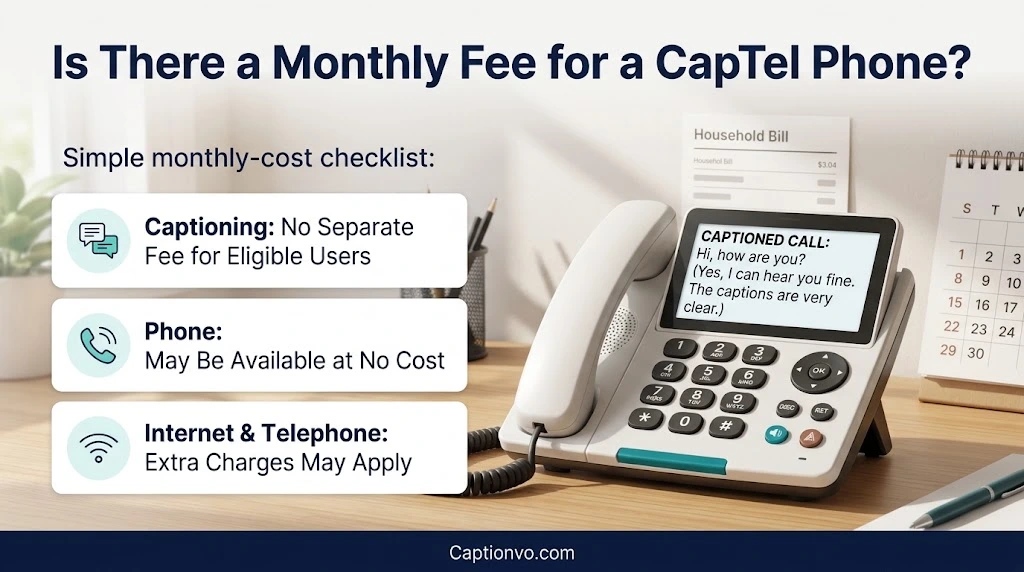
Wondering whether a CapTel phone will add another monthly bill? The key distinction is simple: eligible users pay no separate fee for CapTel’s captioning service, and some may qualify for a phone at no cost. But “free” does not always mean every household expense disappears. Depending on the model and your current setup, internet service, telephone service, or certain calling charges may still apply. Before you apply or buy, learn what CapTel covers, what you might pay separately, and how to check your eligibility. This guide breaks down the costs so you can choose with confidence, without costly surprises later.
If you are Considering Getting a CapTel phone, you may be wondering whether it comes with a monthly fee. The good news is that eligible users do not pay a separate monthly fee for CapTel’s captioning service, and qualifying people with hearing loss may also receive a CapTel phone at no cost.
However, free captioning does not necessarily mean every expense is covered. Depending on your phone model and existing services, you may still need to pay for internet access, telephone service, or additional calling expenses.
CapTel is designed to help people with hearing loss follow telephone conversations by displaying captions of the other person’s spoken words. For many users, this can make everyday communication more accessible and convenient.
In this guide, you will learn how much a CapTel phone costs, what the free service includes, who may qualify for no-cost equipment, and how to avoid unexpected expenses.
1. Does CapTel Charge a Monthly Fee?
No. Eligible users do not pay a separate monthly subscription fee for CapTel’s captioning service.
CapTel provides captioned telephone service through a federally administered telecommunications accessibility program. Instead of charging eligible users a separate monthly fee for captions, the service is supported through the applicable funding arrangement.
A CapTel phone displays the other person’s spoken words as text during a telephone conversation. This allows people who have difficulty hearing speech over the phone to read along while listening and speaking.
It is important, however, to distinguish between the captioning service and the equipment used to access it.
The captioning service has no separate user fee for eligible users, but ordinary telephone and internet charges may still apply. The total cost therefore depends on the equipment you choose and the communication services you already have.
For the latest information, consult CapTel’s official cost guide.
2. How Much Does a CapTel Phone Cost?
The price of a CapTel phone depends on whether you purchase the equipment directly or qualify for a no-cost option.
CapTel’s published cost guide lists a direct-purchase price of $75. It also explains that people with hearing loss may qualify to receive equipment at no cost or at a reduced price through applicable programs.
Because pricing, equipment availability, and program conditions may change, verify the current terms before purchasing a phone.
Here is a breakdown of the potential expenses.
| Expense | Potential cost |
| CapTel Captioning Service | No separate fee for eligible users |
| Phone through an eligible no-cost program | May be available at no cost |
| Direct purchase of a CapTel phone | Published guide lists $75; verify current pricing |
| Existing internet service | Regular provider charges |
| Existing telephone service | Regular provider charges |
| Long-distance calls | Depends on your calling plan |
| Additional telephone line | Additional setup or monthly charges may apply |
| Optional accessories | Depends on the equipment purchased |
These expenses are not all CapTel fees. Some are ordinary household communication costs billed by independent providers.
For example, someone who already has compatible internet and telephone service may not need to add another monthly subscription. Someone who needs a new internet plan or additional telephone line may have extra expenses.
Check the official CapTel pricing page before making a purchasing decision.
3. What Is Included in CapTel’s Free Captioning Service?
CapTel’s captioning service is intended to improve telephone accessibility for people with hearing loss.
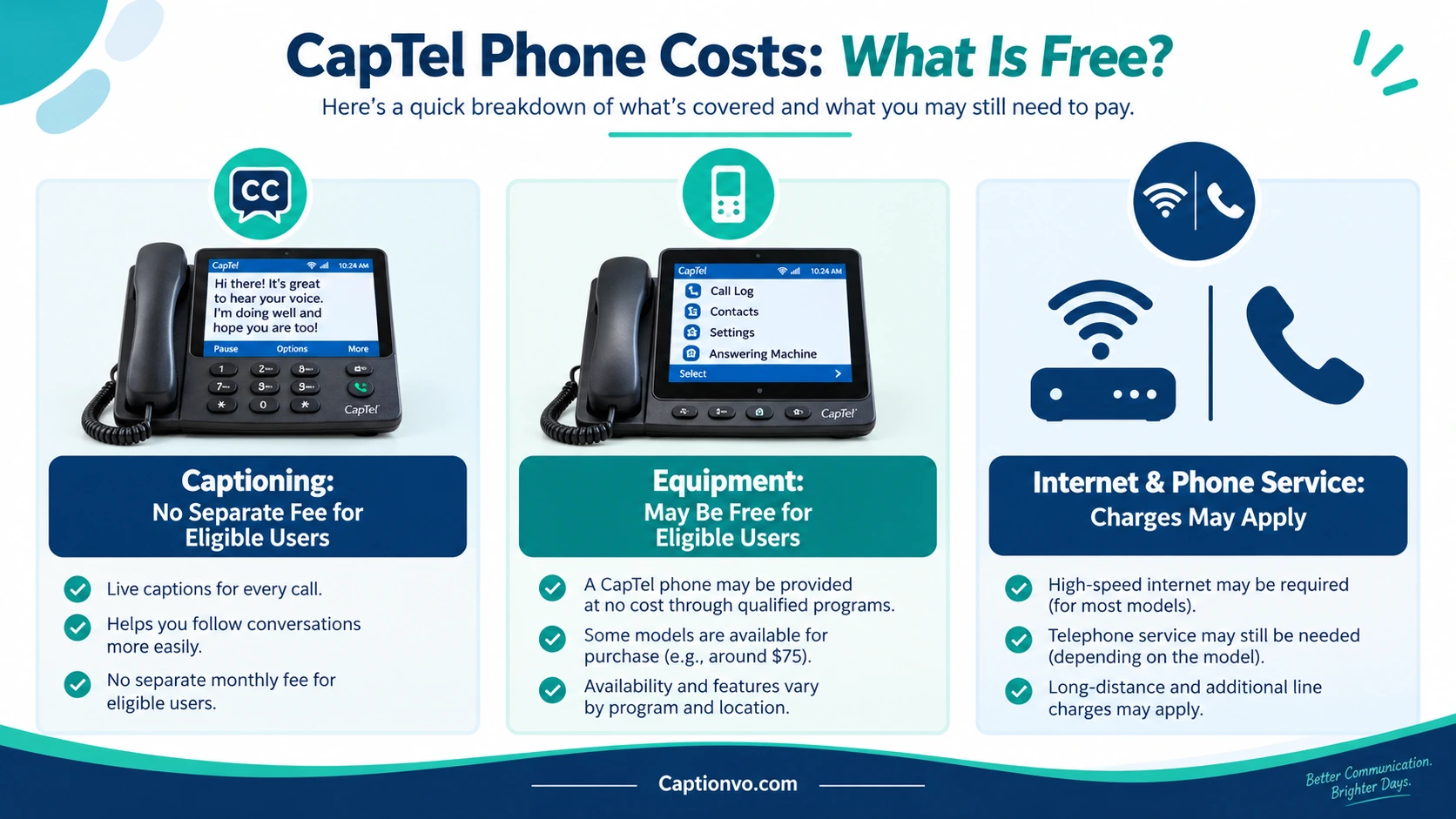
During a supported call, the telephone displays captions of the other person’s spoken words. Users can read these captions while continuing to listen and speak, helping them follow conversations more easily.
For eligible users, the central benefit is access to captioning without a separate monthly captioning subscription.
Depending on the model, a CapTel phone may also offer features such as:
- A large, readable caption display.
- Adjustable text settings.
- Speakerphone functionality.
- Caller ID on supported devices.
- An answering machine on selected models.
- Touchscreen controls and contact-management features on compatible phones.
Not every model includes the same features, so it is worth comparing the specifications before selecting a device.
The no-cost captioning arrangement should not be confused with unlimited free telephone or internet service. Those services may still be billed separately by your providers.
You can learn more about the equipment and service options on the official CapTel website.
4. What Costs Might You Still Have to Pay for CapTel?
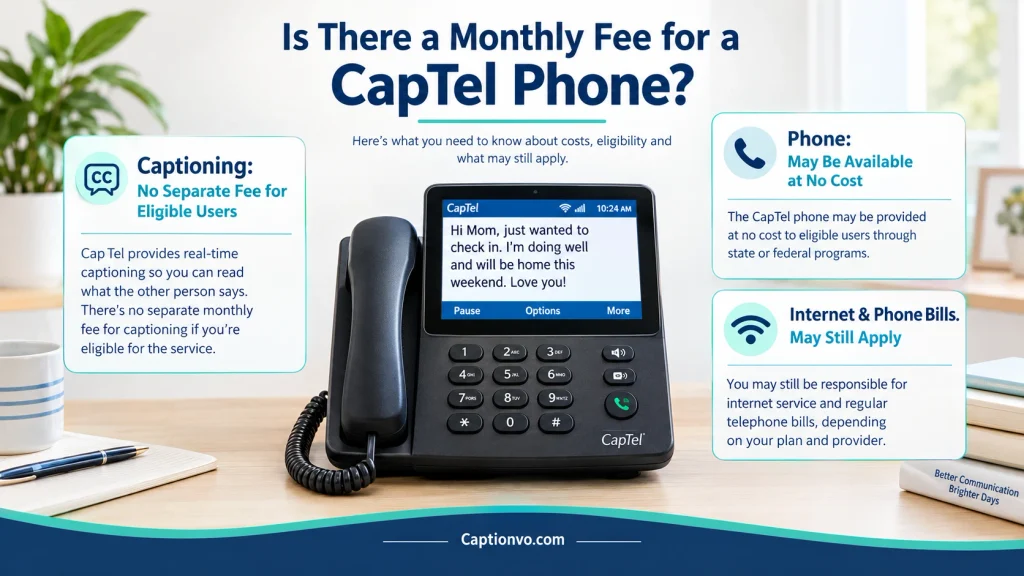
Although eligible users do not pay a separate fee for captioning, certain expenses may remain.
Understanding these expenses before setting up a phone can help you avoid surprises on your household bills.
Internet service charges
Many CapTel models require high-speed internet to provide captions. If you already have compatible internet service, your regular monthly bill generally continues as usual.
If you need a new connection, the internet provider may charge for installation, equipment, or a monthly subscription.
Whether this creates an additional cost depends on your existing setup.
Regular telephone service charges
Some CapTel models require telephone service as well as high-speed internet. The telephone service may be an analog line, DSL, cable telephone, fiber telephone service, or supported VoIP service.
If you do not already have the required service, you may need to arrange a suitable connection.
Long-distance calling charges
The captioning service does not automatically remove charges imposed by your telephone provider.
If your existing calling plan charges for certain long-distance calls, those charges may still apply.
Review your plan to determine whether long-distance calling is included.
Additional telephone-line charges
Certain configurations, including two-line setups, may require an additional telephone line.
If you do not already have the required line, your provider may charge a setup fee or a recurring monthly fee.
This is a separate expense rather than a monthly CapTel captioning fee.
For details, consult CapTel’s two-line service cost guide.
Optional equipment and services
You may also choose accessories or other services that are not included with the basic equipment arrangement.
Before agreeing to an offer, check what is included, what is optional, and whether any additional fees apply.
More to Explore: https://captionvo.com/how-to-have-a-good-caption/
5. Can You Get a CapTel Phone for Free?
Yes. Eligible people with hearing loss may receive a CapTel phone at no cost through the company’s available program.
CapTel also explains that state Equipment Distribution Programs and certain other eligible arrangements may provide equipment free or at a reduced price.
The exact option depends on the applicable program, the applicant’s eligibility, and the equipment available.
A free telephone is particularly helpful for people who need accessible communication equipment but would struggle to afford a direct purchase.
However, receiving the phone at no cost does not automatically cover every related household expense. Internet access, telephone service, and applicable calling charges may remain the user’s responsibility.
To review current options, visit CapTel’s official no-cost phone page.
Check the requirements before applying, because equipment availability and program terms may vary.
6. Who Qualifies for a No-Cost CapTel Phone?
CapTel phones are intended for people with hearing loss who have difficulty hearing telephone conversations.
Eligibility is not determined by age alone. Applicants must meet the applicable requirements for captioned telephone service and complete the necessary registration or certification process.
The exact requirements depend on the service and equipment arrangement.
Before applying, consider the following:
- Whether the intended user has hearing loss that makes captioned telephone service beneficial.
- Whether the selected phone is available through the applicable program.
- Whether registration or hearing-loss certification is required.
- Whether the phone needs high-speed internet or telephone service.
- Whether an existing captioned telephone affects eligibility under the program.
For example, an older adult with hearing loss may qualify for a no-cost phone, but being over a certain age does not automatically guarantee eligibility.
If you are applying on behalf of a parent or another family member, review the current requirements with them.
CapTel provides additional information through its hearing-loss certification page.
7. How Do You Apply for a Free CapTel Phone?
If you believe you qualify, the best starting point is CapTel’s official application process.
Step 1: Visit the official website
Open the CapTel no-cost phone page and review the available options.
Step 2: Review the eligibility requirements
Check whether the intended user meets the requirements for the service and whether certification or registration is necessary.
Step 3: Check your existing connections
Determine whether you already have high-speed internet and compatible telephone service.
This information can help you identify which models may work in your home.
Step 4: Choose the right model
Compare the available displays, controls, features, and connection requirements.
Select a phone that meets the user’s communication needs rather than choosing solely on the basis of appearance or advertised price.
Step 5: Complete the application
Provide the information requested through the official process and follow the instructions for certification and registration.
Step 6: Confirm delivery and setup
Ask whether delivery and installation assistance are available in your location.
Also confirm any telephone or internet arrangements that may create additional expenses.
These steps can help you understand both the application process and the likely cost of using the phone.
8. Does a CapTel Phone Require an Internet Connection?
It depends on the model.
Several popular CapTel models require high-speed internet to provide captions. Certain models also need telephone service, while other options have different connection requirements.
| Model | Internet requirement | Telephone connection |
| CapTel 840i | High-speed internet required | Telephone service required |
| CapTel 880i | High-speed internet required | Telephone service required |
| CapTel 2400i | High-speed internet required | Supported telephone service or an approved internet-only configuration, depending on the model |
| CapTel 840PLUS | Designed for users without high-speed internet | Compatible analog telephone line required |
The models also need the appropriate electrical power and setup.
If you already have high-speed internet, an internet-based model may be a convenient choice. If you do not have internet access, ask CapTel about the options available in your area.
It is important not to assume that all CapTel phones work without internet or that every internet-based model works without telephone service.
For additional information, read CapTel’s official equipment guide.
9. Can You Use a CapTel Phone Without a Landline?
Some CapTel configurations can work without a traditional landline, but the answer depends on the model.
The CapTel 2400i has a supported internet-only VoIP option. With this configuration, calls use an internet-based telephone service rather than a traditional analog telephone line.
A compatible internet-only setup still requires internet access, electrical power, and the applicable registration and configuration.
Other models, such as the 840i and 880i, require telephone service as well as high-speed internet. The 840PLUS is designed for users without high-speed internet and requires a compatible analog telephone line.
There is an important difference between a traditional landline and telephone service in general. A supported VoIP connection may replace a traditional analog line while still functioning as telephone service.
Before canceling an existing telephone plan, confirm that your specific device supports the alternative connection you intend to use.
Read CapTel’s VoIP compatibility information for further details.
10. Do CapTel Phones Have Additional Telephone-Line Charges?
They can, although additional telephone-line charges do not apply to every configuration.
For example, a two-line CapTel setup may require two separate analog telephone lines. If you currently have only one suitable line, your telephone provider may charge for a second line.
These charges may include installation expenses and a recurring monthly service fee.
However, a two-line setup is not necessary for every CapTel model. Requirements differ depending on the equipment and configuration.
Before arranging another line, ask your telephone provider:
- Whether your chosen model actually requires a second line.
- Whether the line can be added to your existing telephone plan.
- What installation charges apply.
- What the monthly service will cost.
- Whether a different supported configuration could meet your needs.
You can also review CapTel’s official two-line requirements.
Remember that a separate telephone-line bill is not the same as a CapTel captioning subscription.
More to Explore: https://captionvo.com/what-are-open-captions/
11. Do Different CapTel Models Have Different Costs?
Yes. CapTel models differ in their features, display designs, and connectivity requirements.
The best choice depends on your communication needs and the services already available in your home.
CapTel 840i
This model has a traditional telephone design and a large display. It requires high-speed internet, telephone service, and electrical power.
CapTel 880i
The 880i offers an extra-large display and is designed for users who prefer a larger screen. It also requires high-speed internet and telephone service.
CapTel 2400i
The 2400i features a touchscreen interface. Supported configurations can include internet-only VoIP service, but the particular model and setup requirements must be checked.
CapTel 840PLUS
The 840PLUS is designed for people without high-speed internet and uses a compatible traditional analog telephone line. Availability may vary by area.
| Model | Main consideration | What to check |
| 840i | Traditional-style design | Internet and telephone requirements |
| 880i | Extra-large display | Connectivity and current availability |
| 2400i | Touchscreen and supported internet-only option | Exact model and activation requirements |
| 840PLUS | No high-speed internet required | Compatible analog line and local availability |
CapTel’s published pricing guide lists $75 for direct purchases, but confirm the current price and availability of the exact model before buying.
You can start your comparison on the official CapTel website.
12. Is CapTel Free for Seniors With Hearing Loss?
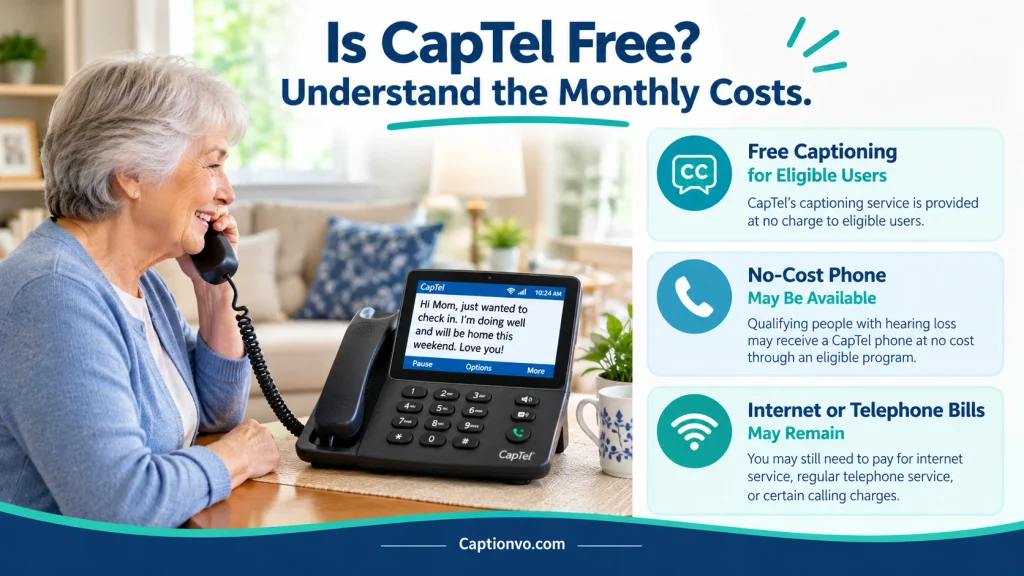
Eligible seniors with hearing loss may qualify for a CapTel phone at no cost.
However, age alone does not guarantee that a person qualifies. Applicants must meet the relevant hearing-loss and registration requirements and select equipment available through an appropriate program.
For older adults, the phone’s usability is also important.
A large display may make captions easier to read. Someone who prefers familiar telephone buttons might find a traditional-style model more comfortable, while a touchscreen may suit someone who is comfortable with modern devices.
Family members can help compare models and arrange the setup, but the intended user must meet the applicable requirements.
The same distinction about household costs applies to seniors: a phone and captioning service may be available at no cost, while existing telephone or internet bills may still need to be paid.
To check the current application process, visit CapTel’s no-cost phone page.
13. How Does CapTel Compare With Other Captioned Phone Services?
CapTel is one option for people who want to read captions during telephone conversations.
Other providers, including CaptionCall, may offer different equipment, features, application processes, or connection arrangements.
Rather than assuming one provider is always cheaper, compare the actual costs and requirements of the services available to you.
| Factor | What to compare |
| Captioning fee | Whether eligible users pay a separate recurring fee |
| Equipment price | Whether the phone is free, loaned, or purchased |
| Internet access | Whether high-speed internet is required |
| Telephone connection | Whether a traditional line or compatible VoIP service is needed |
| Installation | Whether installation support is available |
| Eligibility | Which hearing-loss and registration requirements apply |
| Display and controls | Whether the phone is comfortable and accessible |
| Ongoing costs | Whether the household needs additional communication services |
Your existing services can significantly affect the total cost of ownership.
For example, a phone that is free to obtain may be convenient for a household that already has the required internet and telephone connections. Another configuration may create additional expenses if a new connection is necessary.
Compare the service conditions, not just the equipment price.
For related information, read our Captionvo guide on Is CaptionCall Really Free? once that page is published and the URL is verified.
More to Explore: https://captionvo.com/halloween-costumes/
14. How Can You Avoid Unexpected CapTel Costs?
Before ordering a phone, take a few minutes to identify the services you already have and the services you may need to add.
This simple checklist can help you estimate your expenses.
- Confirm whether you qualify for a no-cost phone.
- Check the current direct-purchase price if you intend to buy one.
- Verify that your chosen model is available.
- Check its high-speed internet requirements.
- Confirm whether telephone service is also necessary.
- Ask whether an additional telephone line is required.
- Review possible long-distance calling charges.
- Check any installation or optional equipment expenses.
- Confirm which support services are included.
- Keep a copy of the applicable eligibility and service terms.
How to estimate your additional monthly cost
Start with the extra internet charges, if any. Add any new telephone plan or line charges and any other recurring costs that your setup requires.
Do not count an existing household bill as a new expense unless the CapTel setup causes that bill to increase.
For example, if you already have the necessary internet and telephone service, you may not need another monthly plan. If you must arrange a new line or internet connection, your recurring expenses may be higher.
This is why the actual cost depends on the user’s circumstances rather than the phone’s advertised price alone.
The best way to avoid unexpected costs is to confirm the model’s requirements and ask your providers about any new charges before completing the setup.
15. People Also Ask About CapTel Monthly Fees
A: Eligible users do not pay a separate monthly fee for CapTel’s captioning service. Regular telephone, internet, and applicable calling charges may still apply.
A: Not necessarily in every situation. Eligible users may receive a phone at no cost, and the captioning service has no separate user fee. Ordinary household communication expenses may remain.
A: CapTel’s published cost guide lists a direct-purchase price of $75. Verify the current price and model availability before purchasing.
A: No. Eligible users do not pay a separate fee for the captioning service.
A: Eligible seniors with hearing loss may qualify. Age alone does not guarantee eligibility; the applicable registration and certification requirements must be met.
Final Thoughts
For eligible people with hearing loss, CapTel can provide accessible telephone conversations without a separate monthly fee for captioning. A qualifying user may also be able to obtain the telephone itself at no cost.
However, free Equipment and captioning do not necessarily cover every household communication expense. Your actual cost depends on the selected model, your eligibility, and your existing telephone and internet services.
Before ordering, verify the current price, equipment availability, connection requirements, and any additional charges with the relevant providers.











1 thought on “CapTel Costs: 4 Things to Know Before You Apply”