What Is a Caption Example? Meaning, Types, and 225 Examples
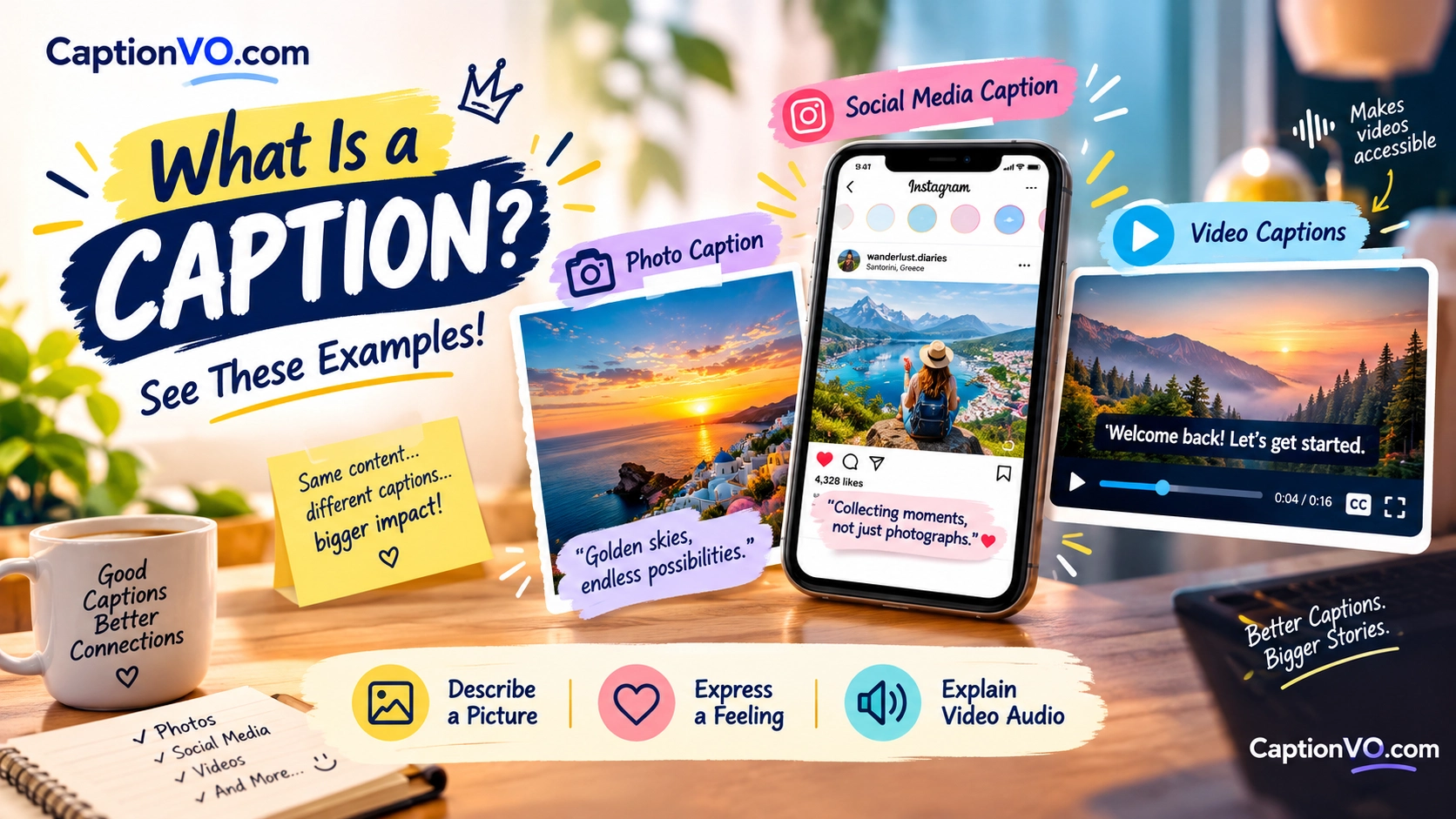
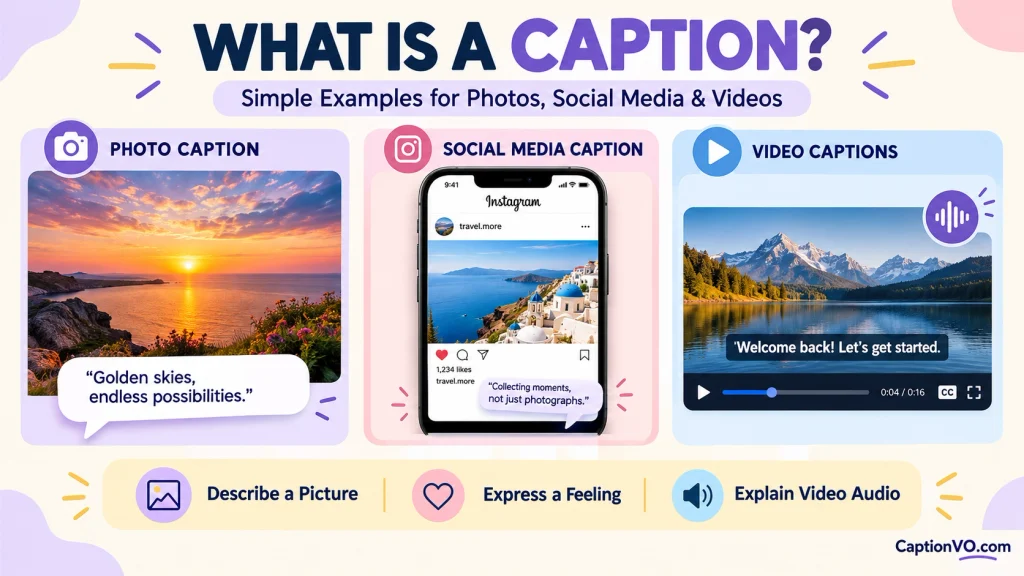
Ever posted a photo and struggled to find the right words? A caption can do more than describe what people see—it can add emotion, explain a moment, or invite a conversation. For example, “Golden skies, endless possibilities” turns a sunset photo into a feeling. But captions look different across Instagram posts, school projects, business updates, and videos. In this guide, you’ll discover what a caption means, explore 225 examples for different situations, and learn a simple formula for writing your own. Whether you want something funny, clear, personal, or informative, you’ll find a starting point here for your next post.
Have you ever posted a photo, watched a video, or opened a social media post and wondered what words would fit it best? Those words might describe the image, express a feeling, explain an important detail, or invite people to respond. They are often called a caption.
What is a Caption Example? A simple example is “A peaceful morning by the sea.” If someone writes this sentence beneath a beach photograph, it adds context and mood to the image. The sentence is a caption because it accompanies the photograph and helps the viewer understand the moment.
Captions are used on Instagram, TikTok, Facebook, blogs, school assignments, news websites, presentations, and videos. Their purpose changes with the situation. A funny social media caption might entertain people, while a school figure caption explains a diagram and a video caption makes spoken words accessible as text.
In this guide, you’ll discover the meaning of a caption, explore 225 caption examples across 15 sections, learn how captions differ from titles and subtitles, and find a simple formula for writing your own.
Quick answer: A caption is a short piece of text that accompanies or appears with visual content to describe it, explain it, add context, express an idea, or communicate spoken words and relevant sounds in a video.
1. What Is a Caption? Meaning and Simple Definition
A caption is text associated with a picture, illustration, chart, video, or social media post. It can describe what is visible, explain the story behind an image, express a feeling, or provide information that the visual alone cannot communicate.
The Cambridge Dictionary definition of caption emphasizes text under a picture that describes the image or explains what people are doing or saying. In modern digital communication, the word is also commonly used for social media copy and synchronized video captions.
Here are 15 examples showing how captions work in different situations.
- Sunset photograph: “The sky saved its brightest colors for last.”
- Family picture: “Another little moment that means everything.”
- Travel photo: “Somewhere new, with plenty left to discover.”
- Food photograph: “Fresh from the kitchen and ready to share.”
- Pet picture: “Small paws, enormous personality.”
- Graduation photo: “A thousand efforts led to this one proud moment.”
- Nature image: “Morning mist rests quietly over the hills.”
- Product photograph: “Designed with thoughtful details for everyday use.”
- School diagram: “The diagram shows the main stages of the water cycle.”
- Museum artwork: “A landscape painting depicting the countryside at dusk.”
- News photograph: “Residents gather for the community’s annual clean-up.”
- Business announcement: “Our newest collection is now available.”
- Sports photograph: “The players celebrate after the final whistle.”
- Video dialogue: “Welcome back! Today, we’re making homemade pizza.”
- Video sound caption: “[A door closes, followed by footsteps.]”
These examples demonstrate that a caption does not always need to be clever, emotional, or long. The right wording depends on what the content needs to communicate.
2. What Is an Example of a Caption?
A caption example is a sentence or short phrase that demonstrates how to describe, explain, or add meaning to a particular image or post.
Imagine a photograph of a bicycle leaning against a wall beside a flower-filled garden. The caption could be “Taking the scenic route, one quiet street at a time.” It connects the image to a sense of exploration rather than simply naming the objects in the photograph.
Here are 15 straightforward caption examples for different situations.
- Rainy day: “Rain outside, peace inside.”
- Coffee break: “A little pause before the next big thing.”
- Birthday: “Another year, another reason to celebrate.”
- Weekend: “Making room for the things that make life feel good.”
- Beach trip: “Salt in the air, nowhere to rush.”
- New haircut: “A fresh look for a fresh chapter.”
- Reading time: “One more chapter before the world calls.”
- Workout: “Showing up is today’s biggest win.”
- Cooking: “A pinch of patience and a plate full of flavor.”
- Best friends: “The people who turn ordinary days into stories.”
- New business: “Built with care, ready to meet you.”
- Office milestone: “Small improvements, meaningful progress.”
- Garden photograph: “A little patience turns seeds into something beautiful.”
- Class presentation: “This chart compares the results from three experiments.”
- Community event: “Neighbors come together to celebrate local creativity.”
What makes these good examples? Each sentence relates to its subject and has a clear purpose. Some describe a moment, others express a feeling, and a few provide factual information. That connection is more important than using complicated language.
3. What Are the Different Types of Captions?
Captions can be descriptive, informative, emotional, humorous, promotional, or designed for accessibility. Choosing a type helps you decide what to write before you start composing the sentence.
These 15 types illustrate the different ways captions can serve an audience.
- Descriptive: “Three sailboats cross the harbor beneath a cloudy sky.”
- Informative: “The library reopened after six months of renovation.”
- Emotional: “Some goodbyes leave a little more love behind.”
- Funny: “My fitness tracker has officially given up on me.”
- Inspirational: “Your next step does not need to be your biggest.”
- Aesthetic: “Soft light, quiet corners, and an unhurried afternoon.”
- Personal storytelling: “I almost stayed home, but this became my favorite day of the month.”
- Educational: “The Moon reflects sunlight rather than producing its own visible light.”
- Promotional: “Discover the new collection and find a design that suits your style.”
- Question-based: “Which part of this journey would you remember most?”
- News-oriented: “Volunteers distribute supplies after the neighborhood storm.”
- Travel: “The road ended here, but the view made the journey worthwhile.”
- Product-focused: “A compact design with room for the essentials.”
- Quote-based: “’The secret of getting ahead is getting started.’ — Mark Twain, commonly attributed.”
- Video accessibility: “[Audience applauds as the speaker returns to the stage.]”
The quote example demonstrates an important writing principle: verify attribution before publishing a quotation. Similarly, factual captions should be checked for accuracy, and video captions should represent the actual audio rather than invented dialogue.
A single caption can also serve more than one purpose. A business post, for example, can describe a product, share useful information, and invite customers to learn more.
4. Why Are Captions Important?
Captions help readers understand what they are seeing and why it matters. On social media, they add personality and context; in education and journalism, they can provide essential factual information.
The following 15 examples show captions written to achieve different communication goals.
- Identify a place: “The old lighthouse stands at the northern end of the bay.”
- Explain a moment: “The team raises the trophy after winning the tournament.”
- Share a feeling: “Today felt like a deep breath after a busy week.”
- Tell a story: “We missed the train, found a tiny café, and discovered our favorite city view.”
- Teach a concept: “Evaporation changes liquid water into water vapor.”
- Start a conversation: “What’s one skill you’d love to learn this year?”
- Announce a launch: “Our handmade notebook collection arrives this Friday.”
- Clarify a chart: “The bars compare annual rainfall across four locations.”
- Recognize a team: “Every person behind this project helped make it happen.”
- Describe a process: “The baker shapes each loaf before placing it in the oven.”
- Set the mood: “Golden light turns the evening streets into a quiet painting.”
- Encourage reflection: “Look how far a few consistent steps can take you.”
- Provide news context: “Emergency crews inspect the road after overnight flooding.”
- Invite a useful action: “Save this checklist before planning your next trip.”
- Support video access: “[The presenter speaks while a demonstration appears on screen.]”
A caption can make content clearer, but it cannot guarantee likes, shares, or viral reach. Engagement depends on many factors, including the audience, the visual, the relevance of the message, and the platform.
For video content, captions serve another important role. The W3C Web Accessibility Initiative explains that captions provide a text version of speech and relevant non-speech audio for people who are Deaf or hard of hearing. This is a different job from writing an entertaining sentence under a social media post.
5. What Are Some Simple Caption Examples for Everyday Posts?
Simple captions work well when you want to share an ordinary moment without turning it into a long story. A few natural words can communicate more effectively than a sentence packed with unnecessary descriptions.
Try these 15 examples for daily life, casual photographs, and personal updates.
- “Just enjoying the little things.”
- “Today, at my own pace.”
- “A moment worth keeping.”
- “Nothing fancy, just happy.”
- “More sunshine, less rushing.”
- “My kind of ordinary magic.”
- “Taking life one cup at a time.”
- “A good day to begin again.”
- “Keeping the memories, not the schedule.”
- “Home feels extra good today.”
- “A little mess, a lot of life.”
- “Found my happy place for the afternoon.”
- “Slow moments, clear thoughts.”
- “One photograph, a hundred little memories.”
- “Today deserves a place in the album.”
How to choose one: Match the words to the actual moment. A calm caption works for a quiet photograph, while a playful line suits a funny snapshot. A simple, relevant sentence is often preferable to a dramatic phrase that does not fit the picture.
6. What Are Some Social Media Caption Examples?
Social media captions accompany photos, videos, carousels, announcements, and other posts. Their tone should reflect the platform, the subject, and the relationship between the creator and the audience.
Contemporary caption guidance from Meta AI’s Instagram caption guide emphasizes adding context, supporting storytelling, using relevant keywords, and inviting an appropriate next action. These are useful practices rather than guaranteed methods for going viral.
Here are 15 examples for different social media situations.
- Instagram carousel: “Swipe through the little details that made this day special.”
- TikTok video: “I tried the recipe everyone kept talking about. Here’s how it went.”
- Facebook family post: “Grateful for an afternoon surrounded by familiar faces.”
- LinkedIn update: “This project reminded me how much clear communication matters.”
- Pinterest idea: “A simple reading-corner setup for a calmer home.”
- Snapchat moment: “Proof that the unplanned moments can be the best.”
- Instagram Reel: “Three tiny changes that made my morning easier.”
- Small-business post: “A closer look at the details behind our newest design.”
- Community announcement: “Join us this Saturday for a neighborhood book exchange.”
- Personal milestone: “A goal that once felt far away is finally becoming real.”
- Behind-the-scenes post: “Here’s what the finished photograph doesn’t show.”
- Tutorial post: “Follow these four steps to organize your desk in less time.”
- Product demonstration: “Watch how the adjustable strap changes the fit.”
- Discussion post: “What’s one piece of advice you wish you’d heard sooner?”
- Creator update: “Testing a new idea this week. I’ll share what I learn.”
Do not publish the exact same caption everywhere without considering the context. A short TikTok caption may suit a quick demonstration, while a LinkedIn update might need more background. The best approach is to preserve your central message and adapt its length, tone, and call to action to the intended audience.
7. What Are Some Photo Caption Examples?
A photo caption can identify the subject, explain when or where the picture was taken, describe an important action, or add a personal interpretation. In factual and editorial settings, the information should be verified rather than guessed.
Here are 15 original photo caption examples.
- Mountain landscape: “Morning clouds drift between the peaks.”
- City skyline: “The last sunlight catches the tallest buildings.”
- Wedding photograph: “Two families celebrate a day filled with promises.”
- Pet portrait: “Milo watches the garden from his favorite window.”
- Graduation photograph: “Graduates gather outside the university hall after the ceremony.”
- Street photography: “A cyclist waits while pedestrians cross the busy intersection.”
- Garden photograph: “Freshly opened roses brighten the corner of the garden.”
- Beach Photograph: “Footprints lead toward the water at low tide.”
- Concert photograph: “The audience raises its hands as the band begins the final song.”
- Food photography: “Roasted vegetables are served with fresh herbs and lemon.”
- Travel portrait: “A traveler pauses at the entrance to the historic market.”
- Sports image: “The goalkeeper reaches for the ball during the second half.”
- Rainy window: “Raindrops blur the streetlights outside the apartment.”
- Product close-up: “The stitched edges reveal the finish of the handmade leather wallet.”
- Historical photograph: “The photograph records the railway station before its later renovation.”
How do you write a caption under a picture?
Start with what you can verify. Ask who or what is shown, what is happening, where the image was taken, and what detail would help the reader understand it.
For a personal photograph, you can add humor or emotion. So for a news image, identify people, places, and events only when those details are known. For a school diagram, explain the information the visual is meant to communicate.
The caption should complement the picture rather than repeat every visible detail.
8. What Are Some Instagram Caption Examples?
Instagram captions can provide context for a photograph, add a personal voice to a Reel, explain a carousel, or help followers respond to a post. The right style depends on what you’re sharing, so a caption that works for a travel photograph may not suit a business announcement.
Use these 15 examples as starting points for your next Instagram post.
- Lifestyle: “Building a life that feels as good as it looks.”
- Selfie: “Showing up as myself, one day at a time.”
- Travel: “A new place, a fresh perspective.”
- Best friends: “Same jokes, different years, still my people.”
- Couple photo: “My favorite plans usually include you.”
- Food post: “The kind of meal that makes everyone stay at the table.”
- Outfit post: “Comfort first, confidence always.”
- Nature: “A little more sky, a little less noise.”
- Fitness: “Progress is built in the moments nobody applauds.”
- Graduation: “One chapter closed, a whole world ahead.”
- Reel tutorial: “Try this simple setup the next time you organize your workspace.”
- Carousel: “Five details from this week that I don’t want to forget.”
- Small-business post: “Made thoughtfully, packed carefully, and ready for its new home.”
- Creative work: “An idea that started as a sketch is finally taking shape.”
- Community question: “What would you add to this little collection of favorites?”
For stronger captions, make the first line relevant and easy to understand. Use keywords naturally where they describe the content, and add a call to action only when it makes sense. Hashtags and emojis can support a message, but they cannot replace useful, accurate wording.
9. What Are Some Caption Examples for School Projects and Presentations?
School captions usually explain photographs, charts, diagrams, maps, artwork, or other visual material. Compared with casual social media captions, they generally prioritize clarity, relevance, and accurate terminology.
Here are 15 examples you can adapt for educational assignments.
- Water cycle diagram: “The water cycle includes evaporation, condensation, and precipitation.”
- Plant biology: “The roots absorb water and minerals from the soil.”
- Solar system model: “The planets orbit the Sun at different distances.”
- Geography map: “The map shows the major rivers crossing the region.”
- Bar chart: “The chart compares the class’s reading totals over six months.”
- History photograph: “The photograph shows a busy street during the early twentieth century.”
- Science experiment: “The solution changes color after the indicator is added.”
- Human anatomy: “The diagram identifies the main bones of the human arm.”
- Weather chart: “The graph displays daily temperature changes during the observation period.”
- Architecture project: “The model demonstrates the proposed layout of the community library.”
- Environmental study: “Native plants grow along the restored section of riverbank.”
- Chemistry illustration: “The illustration represents the arrangement of atoms in a water molecule.”
- Literature presentation: “The timeline highlights key events in the novel’s central conflict.”
- Economics chart: “The line graph shows changes in household spending across the selected years.”
- Art assignment: “The painting uses contrasting colors to create depth and visual emphasis.”
What makes an academic caption effective?
A good academic caption identifies the visual and explains its relevance. Depending on the assignment, you may need a figure number, a brief title, a source credit, or a note about the data.
For example, a formal label could read: “Figure 1. Monthly rainfall measured at the study site.” The caption should describe what the figure actually shows, not make a claim that the data cannot support.
If an image or chart belongs to another person or organization, follow your institution’s citation and permission requirements.
10. What Are Some News and Website Image Caption Examples?
News and website captions typically help readers understand an image without forcing them to search elsewhere for basic context. They may identify an event, location, person, process, or relevant detail.
The 15 examples below demonstrate a clear, factual editorial style.
- Education: “Students take part in a science workshop at the community center.”
- Public transport: “Passengers wait on the platform during the morning commute.”
- Weather: “Rainwater covers part of the road after overnight showers.”
- Environment: “Volunteers plant native trees along the riverbank.”
- Agriculture: “Farm workers sort freshly harvested vegetables in the packing area.”
- Public health: “Medical staff prepare supplies before the community health event begins.”
- Business: “Local retailers display products during the annual market.”
- Construction: “Workers inspect the framework of the new office building.”
- Sports: “Players shake hands after the final match.”
- Culture: “Visitors examine traditional crafts at the weekend exhibition.”
- Research: “Researchers collect water samples for laboratory testing.”
- Community: “Residents meet at the town hall to discuss the proposed park.”
- Wildlife: “A heron stands at the edge of a shallow pond.”
- Technology: “The prototype displays sensor readings during the demonstration.”
- History: “The archival photograph documents the old station before reconstruction.”
Use these as wording models, not as factual captions for unrelated images. When publishing a real news or historical caption, verify the date, place, identities, and circumstances. Avoid inferring a person’s identity, motivation, or participation merely because they appear in a photograph.
For informational websites, a good caption should also complement the surrounding article. An image accompanying a guide to gardening, for example, may need to identify the plant or explain the technique being demonstrated.

11. What Is a Video Caption? Examples of Closed Captions
A video caption is not always the same thing as the sentence written beneath a social media video. In accessibility contexts, captions appear in sync with the audio and represent spoken dialogue and relevant non-speech sounds.
The W3C guidance on captions and subtitles explains this distinction and describes open captions, which remain visible, and closed captions, which viewers can generally turn on or off in a compatible player.
These 15 short examples illustrate how video captions can appear. In a real video, the text must match the actual recording.
- Greeting: “Hello, everyone. Welcome to today’s lesson.”
- Instruction: “First, place the ingredients in a large bowl.”
- Speaker identification: “Maya: Let’s look at the first example.”
- Audience reaction: “[Audience laughs.]”
- Applause: “[The audience applauds.]”
- Telephone sound: “[A phone rings in the background.]”
- Door sound: “[A door opens, followed by footsteps.]”
- Weather sound: “[Thunder rumbles outside.]”
- Music: “[Soft instrumental music plays.]”
- Two speakers: “Alex: Did you finish the report? Sam: I’m checking the final numbers.”
- Cooking instruction: “Stir slowly until the mixture becomes smooth.”
- Outdoor recording: “[Birds chirp as the wind passes through the trees.]”
- Warning announcement: “Please remain behind the marked line.”
- Interview: “Reporter: What changed after the new policy began?”
- Closing statement: “Thank you for watching. I’ll see you next time.”
Open captions vs. closed captions
Open captions are permanently visible within the video image. Closed captions are presented through a player or platform feature that generally allows viewers to toggle them on or off.
Subtitles commonly represent dialogue and may translate it into another language, although terminology varies across regions and platforms. Captions intended for accessibility may also include relevant sounds needed to understand the video.
Automatic speech recognition can save time, but it can mishear names, technical terms, accents, or even small words that change a sentence’s meaning. Review the transcript, speaker labels, punctuation, and timing before publishing.
Platforms such as TikTok provide automatic captioning tools, but creators should still check the results for accuracy and readability. See TikTok’s accessibility information for its current feature guidance.
12. What Is the Difference Between a Caption, Title, Subtitle, and Hashtag?
These terms all relate to text and digital content, but each serves a different purpose. A caption adds context or a message, a title names the content, a hashtag labels a topic, and subtitles or accessibility captions represent video audio in text form.
The following 15 examples demonstrate these distinctions.
- Photo: Caption: “Golden light settles over the empty beach.” Title: “Sunset at the Coast.”
- Travel album: Caption: “Our first morning in the old town.” Title: “A Weekend in Lisbon.”
- Food post: Caption: “Warm bread, fresh butter, and no plans to share.” Hashtag: #FreshBread
- Fitness post: Caption: “Ten minutes today is better than waiting for the perfect hour.” Hashtag: #DailyMovement
- School chart: Caption: “The chart compares energy use across three buildings.” Title: “Building Energy Audit.”
- Video tutorial: Caption beneath the post: “Learn to fold a fitted sheet.” Video caption: “Fold the corners together.”
- Interview: Video caption: “Interviewer: When did the project begin?” Subtitle translation: The same question translated into another language.
- Product photo: Caption: “A compact organizer for everyday essentials.” Title: “The Everyday Organizer.”
- Garden photograph: Caption: “Fresh herbs growing beside the kitchen window.” Hashtag: #KitchenGarden
- Book review: Caption: “A thoughtful story about friendship and second chances.” Title: “A Review of the Novel.”
- News image: Caption: “Fire crews inspect the damaged building on Tuesday.” Article title: “Local Fire Investigation Continues.”
- Event post: Caption: “An afternoon of music, art, and new connections.” Hashtag: #CommunityFestival
- Science video: Video caption: “The sample changes color as the reaction continues.” Video subtitle: A translated version of the spoken explanation.
- Business announcement: Caption: “Our new collection is available to explore.” Title: “Introducing the Autumn Collection.”
- Meme: Caption: “Me opening the fridge for the fifth time.” Hashtag: #RelatableMoments
The comparison shows why the context matters. A caption can include a hashtag, and a video may use captions or subtitles, but these terms are not interchangeable in every situation. When writing for school, publishing, or accessibility, follow the terminology expected by the relevant style guide or platform.
13. How Do You Write a Good Caption? A Step-by-Step Guide
You don’t need to be a professional writer to create a useful caption. Start with the central idea, decide what the audience needs to understand, choose the appropriate tone, and remove anything that does not help.
Use this five-step process:
- Identify the subject. What does the photo, chart, video, or post actually show?
- Choose your purpose. Are you describing, informing, entertaining, expressing a feeling, or asking the reader to take an action?
- Match the tone. Use a casual voice for a personal post, precise wording for a report, and suitable language for a professional announcement.
- Add useful detail. Include a verified fact, personal insight, relevant keyword, or question when it genuinely improves the message.
- Edit and verify. Remove repetition, check names and dates, and make sure the caption accurately reflects the content.
Here are 15 before-and-after examples showing how a caption can become clearer or more engaging.
- Weak: “Nice place.” Improved: “A quiet courtyard tucked behind the city’s busiest street.”
- Weak: “Good food.” Improved: “Fresh pasta, roasted tomatoes, and basil straight from the garden.”
- Weak: “My trip.” Improved: “Three days of mountain views, winding roads, and unexpected stops.”
- Weak: “Great team.” Improved: “Every person on this team contributed to the final result.”
- Weak: “New product.” Improved: “Meet the new desk organizer, designed to keep everyday essentials within reach.”
- Weak: “I am happy.” Improved: “A little good news made this ordinary Tuesday unforgettable.”
- Weak: “School work.” Improved: “This model demonstrates how water moves through the main stages of the water cycle.”
- Weak: “Beautiful flower.” Improved: “A newly opened rose catches the early morning light.”
- Weak: “Big sale.” Improved: “Explore the seasonal collection while the selected items are available.”
- Weak: “Fun day.” Improved: “A spontaneous picnic turned into an afternoon of stories and laughter.”
- Weak: “Read this.” Improved: “Explore the five practical steps before starting your next home project.”
- Weak: “We won.” Improved: “The team celebrates its first tournament victory of the season.”
- Weak: “Important chart.” Improved: “The chart compares quarterly sales across the three product categories.”
- Weak: “Watch video.” Improved: “Follow the demonstration to see how the adjustment works.”
- Weak: “Thanks.” Improved: “Thank you to everyone who contributed time, ideas, and encouragement to this project.”
A caption does not always need to be longer to improve. Sometimes replacing a vague word with a specific detail makes the sentence clearer. For other content, especially formal figure captions or news photographs, a straightforward factual sentence may be the best choice.
14. What Is a Simple Formula for Writing a Caption? With Examples
A useful starting formula is:
Subject + useful detail or feeling + optional next step
The subject tells readers what the content is about. The detail adds context, emotion, or information. The optional next step invites the audience to respond, learn more, or do something relevant.
You do not have to include every component. A simple photograph may need only a few words, whereas a business post or educational graphic may benefit from more explanation.
Here are 15 examples of the formula in practice.
- Travel: “A quiet village + winding streets + no rush to leave = the perfect afternoon.”
- Coffee: “Morning coffee + an open notebook + a fresh plan.”
- Fitness: “A short workout + consistent effort + patience = progress over time.”
- Reading: “One new chapter + a quiet evening + a little imagination.”
- Product launch: “Our new ceramic mugs are here. Explore the colors and choose your favorite.”
- Food: “Fresh tomatoes + garden herbs + a slow simmer = tonight’s homemade sauce.”
- School project: “This model illustrates the stages of the water cycle. Which stage would you explain first?”
- Photography: “Soft evening light + an empty street + a camera ready for the moment.”
- Graduation: “Years of learning + plenty of challenges + one unforgettable milestone.”
- Small business: “Designed for everyday use and made with careful attention to detail. View the new collection.”
- Teamwork: “Different skills + a shared goal + consistent communication.”
- Nature: “A walking trail + cool morning air + views worth the climb.”
- Personal update: “A new chapter + a few unknowns + plenty to look forward to.”
- Educational Reel: “Three useful tips + one quick demonstration. Save the post for your next revision session.”
- Community event: “Local artists + live music + a space for everyone to connect. Join us this weekend.”
Why does this formula work?
It helps you avoid writing without a clear purpose. Before choosing your final wording, decide what the reader should know or feel after seeing the content.
For a personal photo, the feeling may be the most important element. There a product post, a real feature may matter more. For a chart, accuracy and clarity should come before creativity.
If a caption sounds forced, remove one component. The formula is a writing aid, not a rule that every post must follow.
More to Explore: https://captionvo.com/what-are-good-captions/
15. People Also Ask About Caption Examples
A caption is a short piece of text that accompanies a photo, video, or other visual content. For example, “A quiet afternoon beside the lake” is a caption for a lakeside photograph.
A good caption matches its content and purpose. For a sunset photograph, “The day ends in colors worth remembering” adds emotion without making the message complicated.
Write something relevant to the content. Describe what happened, add context, share a feeling, explain a fact, ask a useful question, or invite an appropriate action.
Yes. A single word can work when it communicates the intended mood or message. For instance, “Unforgettable” may fit a photograph of a special occasion.
There is no ideal length for every situation. A personal post might need only a few words, while a tutorial, business update, or educational image may require more detail. Use enough text to communicate the message clearly.
No. A caption is text associated with a visual or post. A quote repeats someone else’s words or presents a quoted statement. A quote can be used as a caption when it suits the content and is attributed accurately.
“Collecting little moments that deserve to be remembered” is an example of a personal Instagram caption. Adapt the wording to suit the photograph and your own voice.
Conclusion:
A caption does more than put words beside an image. It gives context, explains information, expresses emotion, or helps people understand a moment.
The best caption is the one that suits its content and audience. Before publishing, identify your purpose, choose an appropriate tone, add relevant details, and check that the wording is Accurate.
Bookmark this guide whenever you need a fresh example, and explore related caption collections to find a style that fits your next post.











1 thought on “Caption Examples: Find the Right Words for Any Post”