Why Is Having a Caption Phone Illegal? What the Law Really Says
Seeing a warning that says federal law prohibits certain people from using a caption phone with captions turned on can be confusing. Does it mean the phone is illegal to own, or is the restriction about something else?Seeing a warning that says federal law limits caption-phone use can be alarming. Does it mean owning the device is illegal—or that only people can turn on its captions? The key distinction is the service. U.S. rules restrict the use of Internet Protocol Captioned Telephone Service (IP CTS) captions to people who meet registration requirements; they do not create a blanket ban on owning a caption phone. In this guide, you’ll learn what the warning means, who may qualify, whether family members can use the feature, and what to check before activating captions. Get straightforward, clear answers, without scare tactics.
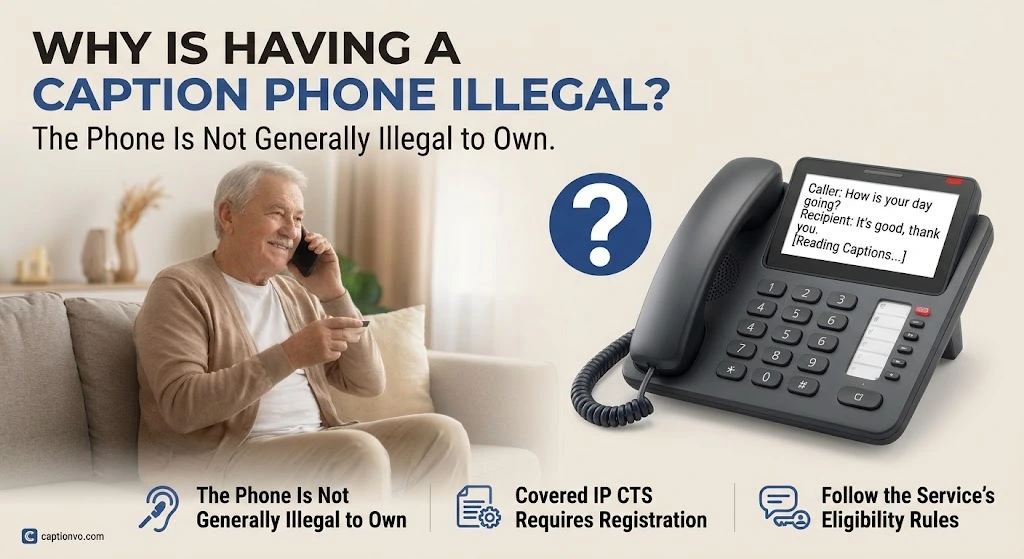
Caption phones are not generally illegal to own. The federal restriction concerns using covered Internet Protocol Captioned Telephone Service (IP CTS) equipment or software with captions enabled without the required registration.
IP CTS is a Telecommunications accessibility service intended for people whose hearing loss makes telephone conversations difficult to understand. Because the service receives federal funding, it has specific eligibility and registration requirements.
These rules explain why caption phones display warning labels, why another person cannot automatically use a registered user’s captioning service, and why buying a used device does not automatically authorize someone to activate its captions.
This guide explains the federal rule in simple English, identifies the legal references worth reading, and shows how to approach captioned telephone service responsibly.
1. Quick Answer: Why Is Having a Caption Phone Illegal?
Having a caption phone is not generally illegal. The restriction applies to using covered IP CTS equipment or software with captions turned on without meeting the relevant registration requirements.
The key provision is 47 CFR § 64.604(c)(11)(ii). It states that a person may not use IP CTS equipment or software with captioning enabled unless the person is registered to use IP CTS under the applicable rules, subject to the rule’s wording and exceptions.
The registration requirements are explained in 47 CFR § 64.611(j).
Why does this restriction exist? IP CTS is part of a federally supported telecommunications accessibility program. Its use is intended for people who need captions because of hearing loss, and the rules help ensure that the service is provided and funded appropriately.
Here is the practical distinction:
| Question | Answer |
| Is owning a caption phone generally illegal? | No. The use restriction is not a general ban on ownership |
| Can anyone automatically activate its IP CTS captions? | No. The applicable registration requirements matter |
| Does a relative automatically inherit the owner’s authorization? | No. Each person’s use must comply with the applicable rules |
| Does buying a used phone give someone permission to use its captions? | No. Purchasing hardware does not automatically establish eligibility or registration |
| Does this rule automatically apply to every smartphone transcription feature? | No. The specific service and technology must be identified |
The important distinction is between the physical telephone and the restricted captioning service.
2. What Is a Caption Phone and How Does It Work?
A caption phone is a telephone that displays text representing the other person’s spoken words during a conversation. It is designed to help people who have difficulty understanding telephone speech because of hearing loss.
For example, someone may hear a caller speaking but struggle to distinguish certain words. The person might misunderstand names, appointment times, addresses, or other important details.
With a captioned telephone, the user can listen while reading text on the screen. This additional information can make conversations easier to follow.
How caption phones produce text
The technical process depends on the provider and service. IP CTS may use speech-recognition technology, a communications assistant, or an applicable combination of methods to produce captions.
The captions appear on compatible telephone equipment or through a supported software application.
Captioned telephone services can be useful when communicating with friends and family, arranging appointments, contacting service providers, or handling other everyday telephone conversations.
The technology itself is not inherently illegal. The federal restriction concerns a particular service and the rules governing its use.
For further background, see CapTel’s explanation of captioned telephones.
3. What Does the Federal Warning Label Actually Mean?
The warning exists because federal regulations specifically address who may use covered IP CTS equipment or software with captions enabled.
Under 47 CFR § 64.604(c)(11)(iii), providers must display a prescribed warning prominently on covered equipment and provide the required notice for applicable software applications.
The label communicates that using the captioning feature is subject to federal requirements. It does not mean that merely possessing the phone is prohibited.
Consider these examples.
Example 1: A registered user
A person who has qualifying hearing loss and completes the applicable registration process uses the service for telephone conversations. This is the type of use the program is designed to support.
Example 2: A relative borrows the telephone
A registered user’s relative wants to make a personal call and turn on the phone’s restricted IP CTS captions. The relative cannot rely solely on the owner’s registration; the applicable rules require the person using the covered captioning service to be registered.
Example 3: A secondhand phone is purchased
Someone buys a used caption phone and assumes that paying for the device automatically authorizes them to use its captioning service. That assumption is incorrect. The person’s authorization and registration must be addressed separately from ownership.
The warning is therefore an important notice about how the service may be used.
4. Why Did the FCC Restrict Captioned Telephone Use?
The restriction is connected to the purpose and funding of telecommunications relay services.
The Americans with Disabilities Act established a framework for telecommunications relay services to help people with hearing or speech disabilities communicate by telephone. IP CTS is one service within this broader accessibility framework.
Eligible service providers may receive compensation for covered captioning use through the Telecommunications Relay Services Fund. The Federal Communications Commission oversees the relevant regulatory framework.
The FCC’s rulemaking concerning misuse of IP CTS explains that registration, warning labels, and caption-activation requirements were adopted to reduce improper use and protect the fund from unnecessary charges. See the 2013 Federal Register rulemaking on IP CTS misuse.
The reasoning is not that reading text during a call is harmful or that all transcription technology should be prohibited.
Instead, the program has a defined accessibility purpose. Rules help ensure that its federally supported services are used by eligible people who need them.
Why not let everyone use the service?
The government has established conditions for reimbursing providers for IP CTS. Allowing unrestricted use regardless of the program’s eligibility requirements could increase the risk of unnecessary service use and improper fund payments.
The registration and use restrictions help keep the service aligned with its intended purpose.

5. Is It Illegal to Own a Caption Phone?
No general prohibition on merely owning a caption phone is established by the IP CTS use restriction discussed here.
A person might encounter caption phone hardware after buying it secondhand, receiving it from a relative, or considering an accessible telephone for home use.
In each case, ownership and authorization to use federally supported captioning are separate questions.
If you possess a caption phone, identify its model and service provider. Confirm whether its captions rely on IP CTS and whether you have completed the relevant registration process before using that service.
A secondhand purchase does not establish eligibility. Likewise, the presence of a screen or a captions button does not by itself tell you which regulatory requirements apply.
Other accessibility technologies may be governed by different requirements. The IP CTS restriction should not be generalized into a claim that all devices displaying speech as text are illegal for people without hearing loss.
More to Explore: https://captionvo.com/can-captioncall-be-used-with-a-cell-phone/
6. Who Is Eligible to Use a Caption Phone?
Eligibility for IP CTS generally requires hearing loss that makes captioned telephone service necessary for effective telephone communication, along with compliance with the applicable registration and certification requirements.
Under 47 CFR § 64.611(j), the registration framework includes information and consumer certification requirements.
A person might benefit from a captioned telephone if they struggle to understand spoken words over calls, even when they can hear the caller’s voice.
However, age alone does not establish eligibility. Neither does a preference for reading text or a general belief that captions are convenient.
Eligibility should be assessed through the applicable service process rather than assumptions about age or hearing ability.
Does everyone with hearing loss qualify?
Not automatically. The important issue is whether the individual’s hearing loss necessitates captioned telephone service under the program’s requirements.
If telephone conversations have become difficult to understand, review the provider’s eligibility instructions and ask questions about the appropriate application process.
7. Can Family Members Use a Caption Phone?
Family Members can generally use a telephone’s ordinary functions, but they must not assume that a registered owner’s authorization allows them to use restricted IP CTS captions.
The distinction matters in households where one accessible telephone is shared by multiple people.
For example, a registered user may have a caption phone in a shared living area. Another household member wants to make a call and activate its IP CTS captioning feature.
The other person must satisfy the applicable registration requirements. The owner’s registration does not automatically transfer to everyone who can access the device.
What if two people in a household need captions?
Each person’s circumstances should be addressed through the provider’s registration process. Ask whether separate registrations, accounts, or equipment arrangements are required.
A household should not assume that one person’s authorization covers another person’s use.
These guidelines help families support accessibility needs without unintentionally misusing a federally supported service.
8. Can You Use Captions If You Have Mild Hearing Loss?
The label “mild hearing loss” does not, by itself, settle whether someone qualifies for IP CTS.
The relevant question is whether the person’s hearing loss makes captions necessary for effective telephone communication under the applicable eligibility requirements.
For example, a person may hear voices in ordinary conversation but struggle to understand telephone speech. Telephone conversations may be difficult because of the audio conditions or the person’s particular hearing needs.
Another person with a hearing impairment may find that a different accessibility tool works better.
If you experience difficulty understanding telephone conversations, explain the problem when reviewing available services and follow the official eligibility process.
Other tools, including amplified telephones, hearing aids, or built-in accessibility features, may also help. Their availability does not automatically establish IP CTS eligibility.
More to Explore: https://captionvo.com/what-is-a-photo-caption/
9. How Does Caption Phone Registration Work?
Registration helps establish who is authorized to use the service and enables providers to meet their regulatory obligations.
The governing requirements are set out in 47 CFR § 64.611(j).
Although exact procedures may differ by provider and individual circumstances, the general process is as follows.
Step 1: Identify a provider.
Research the service, available telephone models, support options, and connectivity requirements.
Step 2: Review the eligibility criteria.
Determine whether the service is intended for your needs and whether your hearing loss makes captioned telephone service necessary under the applicable rules.
Step 3: Complete the registration process.
Provide the information required by the provider and relevant regulations. Use accurate information throughout the process.
Step 4: Complete the required certification.
The process includes certification relating to hearing loss, the captioning service, its funding, and restrictions on use by unregistered people. Depending on the circumstances, additional certification may be required under the governing rules.
Step 5: Follow the activation instructions.
Use the captions according to the provider’s instructions after the appropriate registration and service arrangements are in place.
These are general steps, not a guarantee that every provider has identical documentation requirements.

10. Are Caption Phones Really Free?
Some providers offer captioning services and equipment at no cost to eligible consumers. However, not every telephone, internet connection, mobile plan, accessory, or related service is necessarily free.
IP CTS captioning use can be compensated through the Telecommunications Relay Services Fund. That funding mechanism supports the provision of eligible services.
The cost of the equipment and the consumer’s other communications services is a separate consideration.
For example, an eligible person may receive a caption phone at no cost while continuing to pay for household internet access.
Before signing up, ask the provider whether equipment is supplied at no cost, whether the captioning service is free to eligible users, what connection is required, and whether any other charges apply.
For an example of provider-specific information, consult CapTel’s caption phone resources or ClearCaptions’ FAQs.
Important: A service’s no-cost status does not remove its eligibility or registration requirements.
11. Is the Caption Phone Rule About Wiretapping or Privacy?
The Specific IP CTS restriction is principally about authorized use of a federally supported accessibility service. It should not be confused with a blanket prohibition on recording telephone calls.
Some consumers wonder how captions are produced and whether another person can hear a conversation. That is a reasonable question, particularly for telephone conversations involving personal or sensitive information.
The technical process depends on the provider and service. Some IP CTS arrangements use speech recognition, while others may involve a communications assistant.
The registration warning does not establish that every caption phone is a wiretapping device. Nor does it determine the legality of every other type of call recording or transcription.
If privacy is a concern, read the provider’s privacy policy and ask how it processes call audio, captions, and account information. Separate recording or disclosure questions may involve other laws and depend on the facts.
12. What Happens If an Unregistered Person Turns on Captions?
The applicable federal rule prohibits a person from using covered IP CTS equipment or software with the captioning enabled unless the person is registered under the relevant requirements, subject to the rule’s wording and exceptions.
If someone realizes that they have activated the restricted feature without the appropriate registration, the sensible next step is to stop using that feature and contact the provider for guidance.
For example, a relative who borrows the phone should not continue making captioned calls on the assumption that the owner’s registration provides automatic authorization.
If the relative independently needs captioning, they should review the eligibility requirements and ask the provider about registering correctly.
It would be inaccurate to claim that every accidental activation automatically causes arrest, a fine, or a specific criminal penalty. The legal restriction is clear, but the outcome of an individual incident depends on the circumstances and applicable law.
Take the warning seriously without confusing the existence of a use restriction with a claim that every mistake produces an identical legal consequence.
13. Do the Same Rules Apply to Every Phone and Captioning App?
No. The technology and service involved must be identified before applying the IP CTS rules.
A dedicated captioned telephone or a supported application that provides federally regulated IP CTS is not necessarily equivalent to a smartphone’s general speech-to-text feature.
Other technologies may include:
- Built-in accessibility captions.
- General transcription tools.
- Meeting and video captions.
- Speech-to-text features.
- Other communication accessibility services.
These tools may have separate terms of use, technical limitations, and privacy requirements.
Their existence does not mean that every technology is subject to the same IP CTS registration rule. Equally, the availability of a speech-to-text feature does not exempt a service that actually falls under IP CTS from the applicable federal requirements.
Before drawing a conclusion, check the provider, device, and service that generate the captions.
More to Explore: https://captionvo.com/is-there-a-monthly-fee-for-a-captel-phone/
14. How to Get a Caption Phone Through the Proper Process
If you have difficulty understanding telephone conversations, there are several practical steps to explore captioned telephone service.
Identify your communication needs. Consider whether you regularly misunderstand telephone speech and whether reading captions could help you communicate effectively.
Research providers. Compare available equipment, application options, support services, connectivity needs, and current eligibility criteria.
Complete the correct application. Supply accurate information and complete the applicable registration and certification requirements.
Check the full cost. Confirm whether the device and captioning service are supplied at no cost and whether internet, telephone, or mobile service charges remain.
Use the service as authorized. Ensure that the person using the restricted IP CTS captioning feature is properly registered.
Ask questions before sharing or activating equipment. Contact the provider if you inherit a telephone, change devices, share a household, or are uncertain about your registration.
For the authoritative legal details, consult 47 CFR § 64.604 and 47 CFR § 64.611.

15. People Also Ask About Caption Phone Laws
A: No general ban on owning a caption phone is established by the IP CTS captions-use restriction. The important distinction is whether the person is authorized to use the covered captioning service.
A: Federal regulations require providers to display a warning about the restricted use of covered IP CTS equipment and software. The notice informs users that the captioning service is subject to registration requirements.
A: A family member may generally use ordinary telephone functions, but they should not use the covered IP CTS captioning service without satisfying the applicable registration requirements.
A: Yes, purchasing a device is a separate question from authorization to use its captioning service. Check the model and provider’s requirements before activating IP CTS captions.
A: No. Eligibility concerns hearing loss, the need for captioned telephone service, and the applicable registration requirements—not age alone.
A: Some providers offer equipment and captioning service at no cost to eligible consumers. Other costs, including internet or telephone access, may still apply.
Final Thoughts
Caption Phones are not generally illegal to own. Federal rules restrict the use of covered IP CTS equipment or software with captions enabled to people who meet the applicable registration requirements.
The distinction is simple: owning a device does not automatically authorize its federally supported captioning service. By checking eligibility, completing registration, and following the provider’s instructions, consumers can better understand how to use captioned telephone services responsibly.











1 thought on “Caption Phone Laws: 3 Rules You Should Know”